import pandas as pd
import numpy as np
import matplotlib.pyplot as plt
import seaborn as sns

import os
import zipfile,kaggle
from fastai.imports import *

import xgboost as xgb
from sklearn.metrics import mean_squared_error

from nbdevAuto.functions import *
import nbdevAuto.functionsXGBoost: Forecast Energy Consumption
color_pal = sns.color_palette()
plt.style.use('fivethirtyeight')

name = 'hourly-energy-consumption'
path = Path(f'Data/{name}')
user = 'robikscube'
kaggle_dataset_download(user = user,
                         name = name)
file existsdf = pd.read_csv(f'{path}/PJME_hourly.csv')
df = df.set_index('Datetime')
df.index = pd.to_datetime(df.index)df.plot(style='.',
figsize=(15, 5),
color=color_pal[0],
title='PJME Energy Use in MW')
plt.show()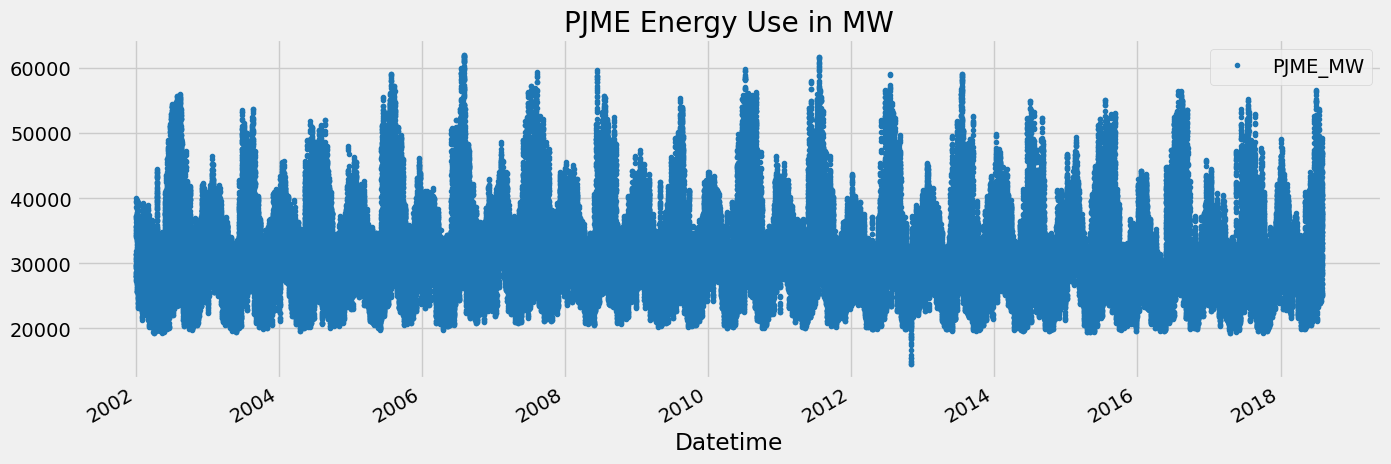
1. Outlier Analysis and removal
df['PJME_MW'].plot(kind='hist', bins=500)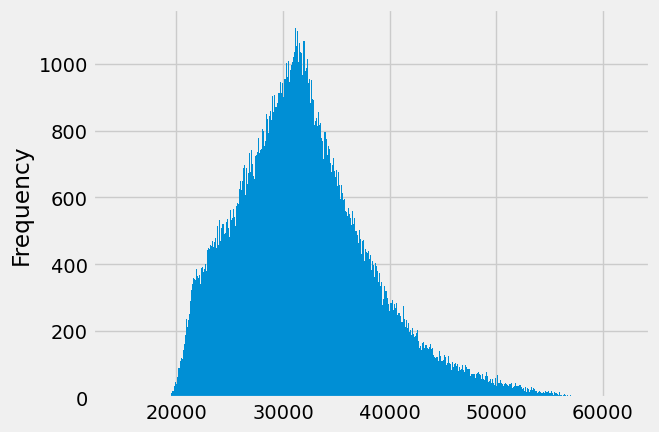
df.query('PJME_MW < 19_000')['PJME_MW'] \
    .plot(style='.',
          figsize=(15, 5),
          color=color_pal[5],
          title='Outliers')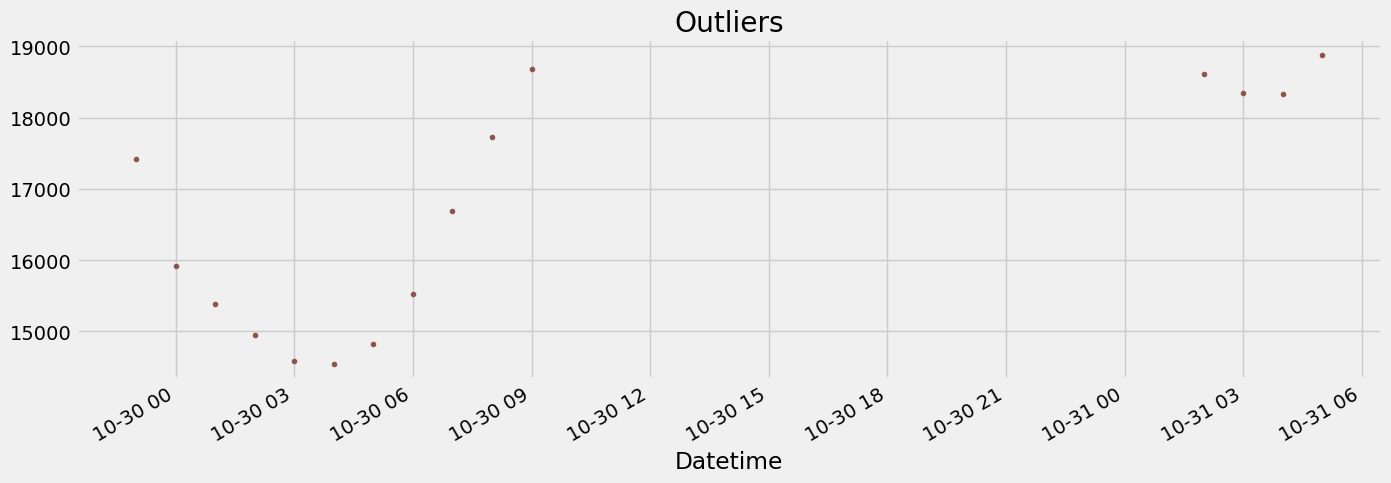
df = df.query('PJME_MW > 19_000').copy()Reviewing: Train / Test Split
train = df.loc[df.index < '01-01-2015']
test = df.loc[df.index >= '01-01-2015']

fig, ax = plt.subplots(figsize=(15, 5))
train.plot(ax=ax, label='Training Set', title='Data Train/Test Split')
test.plot(ax=ax, label='Test Set')
ax.axvline('01-01-2015', color='black', ls='--')
ax.legend(['Training Set', 'Test Set'])
plt.show()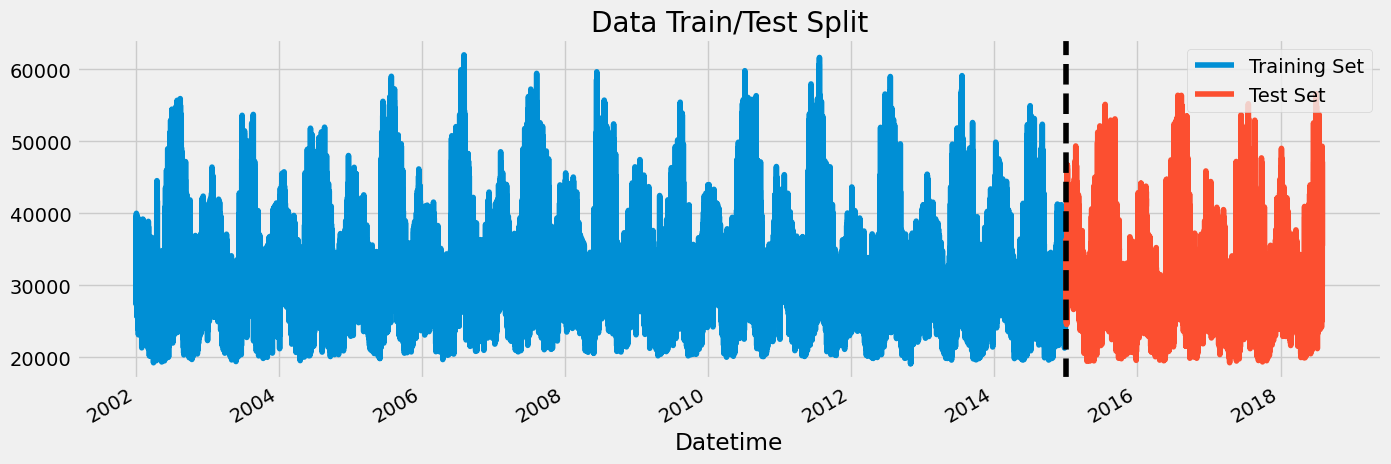
1. Time Series Cross Validation
from sklearn.model_selection import TimeSeriesSplit

tss = TimeSeriesSplit(n_splits=5, test_size=24*365*1, gap=24)
df = df.sort_index()
fig, axs = plt.subplots(5, 1, figsize=(15, 15), sharex=True)
fold = 0
for train_idx, val_idx in tss.split(df):
train = df.iloc[train_idx]
test = df.iloc[val_idx]
train['PJME_MW'].plot(ax=axs[fold],
label='Training Set',
title=f'Data Train/Test Split Fold {fold}')
test['PJME_MW'].plot(ax=axs[fold],
label='Test Set')
axs[fold].axvline(test.index.min(), color='black', ls='--')
fold += 1
plt.show()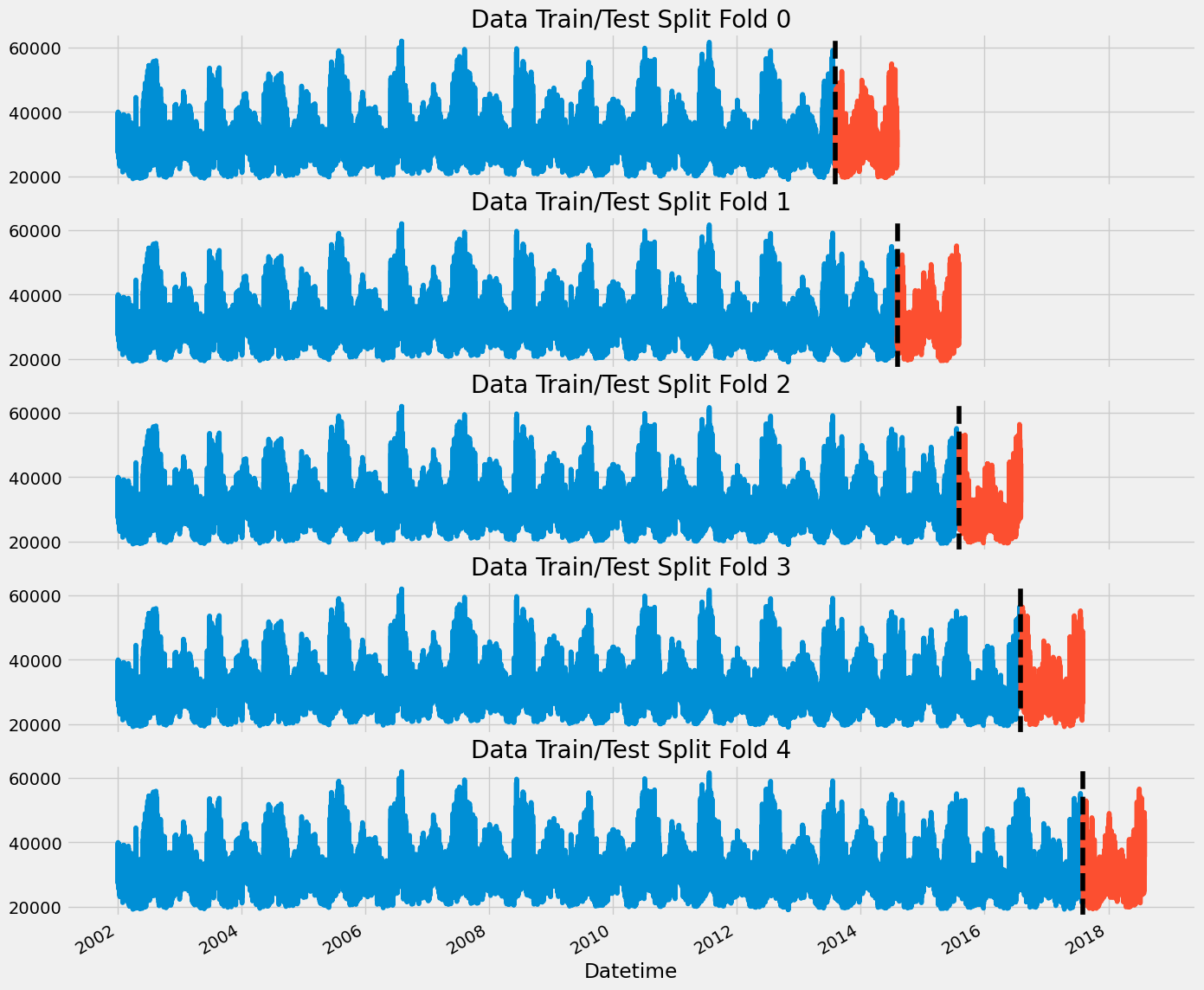
2. Forecasting Horizon Explained
The forecast horizon is the length of time into the future for which forecasts are to be prepared. These generally vary from short-term forecasting horizons (less than three months) to long-term horizons (more than two years).
def create_features(df):
    """
    Create time series features based on time series index.
    """
    df = df.copy()
    df['hour'] = df.index.hour
    df['dayofweek'] = df.index.dayofweek
    df['quarter'] = df.index.quarter
    df['month'] = df.index.month
    df['year'] = df.index.year
    df['dayofyear'] = df.index.dayofyear
    df['dayofmonth'] = df.index.day
    df['weekofyear'] = df.index.isocalendar().week
    return df

df = create_features(df)
3. Lag Features
- What was the target (x) days in the past.
def add_lags(df):
    target_map = df['PJME_MW'].to_dict()
    df['lag1'] = (df.index - pd.Timedelta('364 days')).map(target_map)
    df['lag2'] = (df.index - pd.Timedelta('728 days')).map(target_map)
    df['lag3'] = (df.index - pd.Timedelta('1092 days')).map(target_map)
    return df
df = add_lags(df)Train Using Cross Validation
tss = TimeSeriesSplit(n_splits=5, test_size=24*365*1, gap=24)
df = df.sort_index()


fold = 0
preds = []
scores = []
for train_idx, val_idx in tss.split(df):
    train = df.iloc[train_idx]
    test = df.iloc[val_idx]

    train = create_features(train)
    test = create_features(test)

    FEATURES = ['dayofyear', 'hour', 'dayofweek', 'quarter', 'month','year',
                'lag1','lag2','lag3']
    TARGET = 'PJME_MW'

    X_train = train[FEATURES]
    y_train = train[TARGET]

    X_test = test[FEATURES]
    y_test = test[TARGET]

    reg = xgb.XGBRegressor(base_score=0.5, booster='gbtree',
                           n_estimators=1000,
                           early_stopping_rounds=50,
                           objective='reg:linear',
                           max_depth=3,
                           learning_rate=0.01)
    reg.fit(X_train, y_train,
            eval_set=[(X_train, y_train), (X_test, y_test)],
            verbose=100)

    y_pred = reg.predict(X_test)
    preds.append(y_pred)
    score = np.sqrt(mean_squared_error(y_test, y_pred))
    scores.append(score)
[0] validation_0-rmse:32732.49608 validation_1-rmse:31956.60163/home/thekkel/mambaforge/envs/cfast/lib/python3.11/site-packages/xgboost/core.py:160: UserWarning: [17:58:44] WARNING: /workspace/src/objective/regression_obj.cu:209: reg:linear is now deprecated in favor of reg:squarederror.
warnings.warn(smsg, UserWarning)[100] validation_0-rmse:12532.64369 validation_1-rmse:11906.14134
[200] validation_0-rmse:5747.92495 validation_1-rmse:5359.26490
[300] validation_0-rmse:3872.48134 validation_1-rmse:3900.86965
[400] validation_0-rmse:3434.23853 validation_1-rmse:3762.33705
[442] validation_0-rmse:3369.34730 validation_1-rmse:3764.82810
[0] validation_0-rmse:32672.16678 validation_1-rmse:32138.89241/home/thekkel/mambaforge/envs/cfast/lib/python3.11/site-packages/xgboost/core.py:160: UserWarning: [17:58:47] WARNING: /workspace/src/objective/regression_obj.cu:209: reg:linear is now deprecated in favor of reg:squarederror.
warnings.warn(smsg, UserWarning)[100] validation_0-rmse:12513.65574 validation_1-rmse:12224.93373
[200] validation_0-rmse:5753.34937 validation_1-rmse:5662.07107
[300] validation_0-rmse:3902.71304 validation_1-rmse:3933.73076
[400] validation_0-rmse:3476.90515 validation_1-rmse:3590.55005
[500] validation_0-rmse:3353.72424 validation_1-rmse:3516.39915
[600] validation_0-rmse:3297.94766 validation_1-rmse:3481.94003
[700] validation_0-rmse:3258.48267 validation_1-rmse:3461.37383
[800] validation_0-rmse:3221.51553 validation_1-rmse:3436.49603
[900] validation_0-rmse:3190.11480 validation_1-rmse:3428.88699
[999] validation_0-rmse:3166.16314 validation_1-rmse:3420.31309
[0] validation_0-rmse:32631.20370 validation_1-rmse:31073.29733/home/thekkel/mambaforge/envs/cfast/lib/python3.11/site-packages/xgboost/core.py:160: UserWarning: [17:58:52] WARNING: /workspace/src/objective/regression_obj.cu:209: reg:linear is now deprecated in favor of reg:squarederror.
warnings.warn(smsg, UserWarning)[100] validation_0-rmse:12499.28425 validation_1-rmse:11136.70202
[200] validation_0-rmse:5750.81453 validation_1-rmse:4813.22087
[300] validation_0-rmse:3917.04200 validation_1-rmse:3553.46419
[400] validation_0-rmse:3494.55924 validation_1-rmse:3495.32356
[410] validation_0-rmse:3476.66883 validation_1-rmse:3502.25535
[0] validation_0-rmse:32528.44438 validation_1-rmse:31475.39670/home/thekkel/mambaforge/envs/cfast/lib/python3.11/site-packages/xgboost/core.py:160: UserWarning: [17:58:55] WARNING: /workspace/src/objective/regression_obj.cu:209: reg:linear is now deprecated in favor of reg:squarederror.
warnings.warn(smsg, UserWarning)[100] validation_0-rmse:12462.36581 validation_1-rmse:12020.28283
[200] validation_0-rmse:5738.57925 validation_1-rmse:5796.45874
[300] validation_0-rmse:3918.53218 validation_1-rmse:4388.39477
[400] validation_0-rmse:3501.24270 validation_1-rmse:4173.36380
[500] validation_0-rmse:3384.02490 validation_1-rmse:4119.56538
[600] validation_0-rmse:3325.50024 validation_1-rmse:4105.01446
[700] validation_0-rmse:3282.73755 validation_1-rmse:4091.23557
[800] validation_0-rmse:3250.37610 validation_1-rmse:4083.12690
[900] validation_0-rmse:3223.87814 validation_1-rmse:4081.46154
[999] validation_0-rmse:3199.82843 validation_1-rmse:4052.57120
[0] validation_0-rmse:32462.05557 validation_1-rmse:31463.90500/home/thekkel/mambaforge/envs/cfast/lib/python3.11/site-packages/xgboost/core.py:160: UserWarning: [17:59:02] WARNING: /workspace/src/objective/regression_obj.cu:209: reg:linear is now deprecated in favor of reg:squarederror.
warnings.warn(smsg, UserWarning)[100] validation_0-rmse:12445.87740 validation_1-rmse:11963.42706
[200] validation_0-rmse:5752.44568 validation_1-rmse:5611.92884
[300] validation_0-rmse:3951.51709 validation_1-rmse:4156.41403
[400] validation_0-rmse:3539.25569 validation_1-rmse:4006.58873
[440] validation_0-rmse:3479.88018 validation_1-rmse:4011.05271print(f'Score across folds {np.mean(scores):0.4f}')
print(f'Fold scores:{scores}')Score across folds 3742.5833
Fold scores:[3760.8277187583353, 3420.313091887879, 3478.018038580526, 4052.5712055405547, 4001.186553933809]4. Predicting the Future
- Retraining on all data
- To Predict the future we need an emtpy dataframe for future date ranges.
- Run those dates through our feature creation code + lag creation
# Retrain on all data
df = create_features(df)

FEATURES = ['dayofyear', 'hour', 'dayofweek', 'quarter', 'month', 'year',
            'lag1','lag2','lag3']
TARGET = 'PJME_MW'

X_all = df[FEATURES]
y_all = df[TARGET]

reg = xgb.XGBRegressor(base_score=0.5,
                       booster='gbtree',
                       n_estimators=500,
                       objective='reg:linear',
                       max_depth=3,
                       learning_rate=0.01)
reg.fit(X_all, y_all,
        eval_set=[(X_all, y_all)],
        verbose=100)
[0] validation_0-rmse:32403.88991/home/thekkel/mambaforge/envs/cfast/lib/python3.11/site-packages/xgboost/core.py:160: UserWarning: [17:59:05] WARNING: /workspace/src/objective/regression_obj.cu:209: reg:linear is now deprecated in favor of reg:squarederror.
warnings.warn(smsg, UserWarning)[100] validation_0-rmse:12426.83220
[200] validation_0-rmse:5751.73275
[300] validation_0-rmse:3971.53256
[400] validation_0-rmse:3571.21833
[499] validation_0-rmse:3456.76877XGBRegressor(base_score=0.5, booster='gbtree', callbacks=None,
colsample_bylevel=None, colsample_bynode=None,
colsample_bytree=None, device=None, early_stopping_rounds=None,
enable_categorical=False, eval_metric=None, feature_types=None,
gamma=None, grow_policy=None, importance_type=None,
interaction_constraints=None, learning_rate=0.01, max_bin=None,
max_cat_threshold=None, max_cat_to_onehot=None,
max_delta_step=None, max_depth=3, max_leaves=None,
min_child_weight=None, missing=nan, monotone_constraints=None,
multi_strategy=None, n_estimators=500, n_jobs=None,
num_parallel_tree=None, objective='reg:linear', ...)In a Jupyter environment, please rerun this cell to show the HTML representation or trust the notebook. On GitHub, the HTML representation is unable to render, please try loading this page with nbviewer.org.
XGBRegressor(base_score=0.5, booster='gbtree', callbacks=None,
             colsample_bylevel=None, colsample_bynode=None,
             colsample_bytree=None, device=None, early_stopping_rounds=None,
             enable_categorical=False, eval_metric=None, feature_types=None,
             gamma=None, grow_policy=None, importance_type=None,
             interaction_constraints=None, learning_rate=0.01, max_bin=None,
             max_cat_threshold=None, max_cat_to_onehot=None,
             max_delta_step=None, max_depth=3, max_leaves=None,
             min_child_weight=None, missing=nan, monotone_constraints=None,
             multi_strategy=None, n_estimators=500, n_jobs=None,
num_parallel_tree=None, objective='reg:linear', ...)df.index.max()Timestamp('2018-08-03 00:00:00')# Create future dataframe
future = pd.date_range('2018-08-03','2019-08-01', freq='1h')
future_df = pd.DataFrame(index=future)
future_df['isFuture'] = True
df['isFuture'] = False
df_and_future = pd.concat([df, future_df])
df_and_future = create_features(df_and_future)
df_and_future = add_lags(df_and_future)future_w_features = df_and_future.query('isFuture').copy()Predict the future
future_w_features['pred'] = reg.predict(future_w_features[FEATURES])future_w_features['pred'].plot(figsize=(10, 5),
color=color_pal[4],
ms=1,
lw=1,
title='Future Predictions')
plt.show()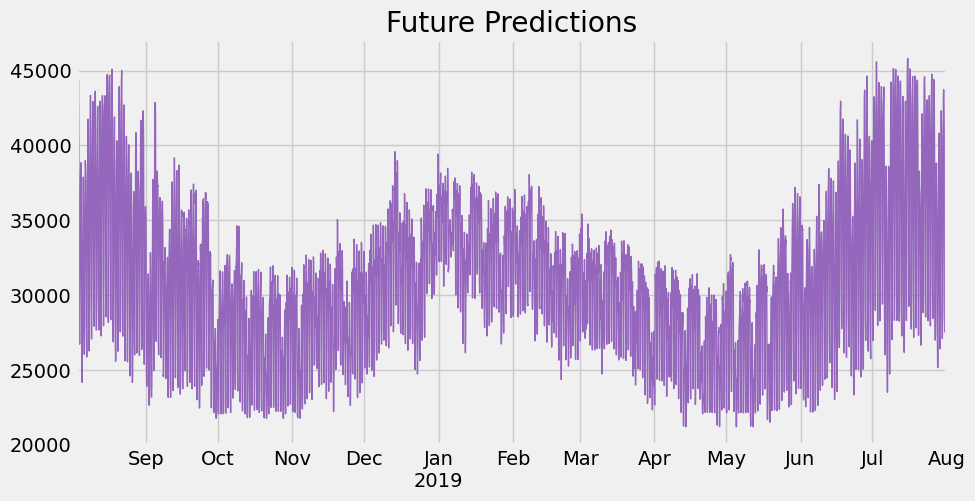
Bonus: Saving Model For later
# Save model
reg.save_model('model.json')
reg_new = xgb.XGBRegressor()
reg_new.load_model('model.json')
future_w_features['pred'] = reg_new.predict(future_w_features[FEATURES])
future_w_features['pred'].plot(figsize=(10, 5),
color=color_pal[4],
ms=1, lw=1,
title='Future Predictions')
On this site’s backtest
The tutorial above uses the PJM East dataset and its cells do not run here. This section runs XGBoost on the household series with the backtest every other model uses, and with the feature set that scored best on the Feature Engineering page (seasonal lags, calendar, Fourier terms and rolling statistics, all known 24 hours ahead), imported from ML_Timeseries.features. The model trains once on everything before the first test origin.
import numpy as np
import pandas as pd
import xgboost as xgb

from ML_Timeseries.backtest import backtest, future_index, origins, record, score
from ML_Timeseries.data import load_household
from ML_Timeseries.features import make_features
hh = load_household()
y, FILLED = hh["kwh"], hh["filled"]
train = y.iloc[:origins(y.index)[0]]
model = xgb.XGBRegressor(n_estimators=600, learning_rate=0.03, max_depth=6, subsample=0.8, colsample_bytree=0.8,
tree_method="hist", n_jobs=1, random_state=0)
model.fit(make_features(train).iloc[700:], train.iloc[700:])
def xgb_forecaster(history, horizon):
ext = pd.concat([history.iloc[-800:], pd.Series(np.nan, index=future_index(history, horizon))])
return model.predict(make_features(ext).iloc[-horizon:])
xgb_score = score(backtest(y, xgb_forecaster), y, exclude=FILLED)
_ = record("XGBoost, engineered features", "machine learning", xgb_score, notebook="04_Machine_Learning/05_XGBoost_Energy")
print(f"XGBoost: MASE {xgb_score['mase']:.3f}, skill {xgb_score['skill']:+.1%}")XGBoost: MASE 0.663, skill +17.5%XGBoost lands within half a point of scikit-learn’s histogram gradient boosting on the same features (both about +17% skill against seasonal naive). The two libraries implement the same idea, boosted regression trees on binned features, and on a table of a few dozen columns their differences in regularisation and tree growth barely register. The Feature Engineering ablation showed where the gains come from: the features, and above all the calendar. Choose between XGBoost, LightGBM and scikit-learn on speed, deployment and API, not on expected accuracy.