Everything to know about turning a text prompt into a 3D asset: representations, the SDS-vs-feed-forward split, the mid-2026 model landscape, why evaluation is still weak, and runnable code (Shap-E in diffusers) to generate, render and export a mesh on a 12 GB card.
Author
Benedict Thekkel
1. What is Text-to-3D?
Text-to-3D maps a natural-language prompt (“a wooden rocking chair”) to a 3D asset. Unlike text-to-image, there is no single canonical output format: the task is only defined once you say which representation you want back. That choice is the whole design decision, and everything else in the pipeline follows from it.
Input. A text prompt, encoded by a frozen text encoder (CLIP text tower in Shap-E and Point-E; T5 / CLIP in the diffusion priors; a VLM caption embedding in the newest systems).
Output. One of these, and they are not interchangeable:
Representation
What it is
Pros
Cons
Who wants it
Point cloud
Unordered (x, y, z) + colour samples
Trivial to generate, permutation-invariant, cheap
No surface, no topology, cannot be textured or rendered directly
Intermediate only (Point-E)
Voxel grid
Occupancy/colour on a 3D lattice
Convolution-friendly, simple
Memory is O(n^3); 512^3 is already huge; blocky
Coarse stage of generators (TRELLIS sparse voxels)
Mesh (triangles + UVs + textures)
Vertices, faces, UV map, PBR material maps
The only thing game engines and DCC tools actually ingest; riggable, animatable, editable
Hard to generate directly (irregular, variable topology)
Games, film, AR/VR, product viz, 3D print
Implicit field (SDF / occupancy)
A network f(x, y, z) -> distance or inside/outside
Arbitrary resolution, watertight by construction, smooth
Must be marching-cubed to a mesh; extraction is lossy and produces dense, ugly topology
Slow to fit and to render, not a mesh, no material separation
Optimisation-based methods (DreamFusion)
3D Gaussian Splatting (2023)
Millions of explicit anisotropic 3D Gaussians
Real-time rasterised rendering, explicit, fast to fit; now dominant for capture
Not a mesh either; enormous file sizes; meshing a splat is its own research problem
Capture / scene reconstruction, and one of TRELLIS’s output heads
Structured / native 3D latent
A compact learned latent grid that decodes to any of the above
Lets a single diffusion model be trained on 3D data and emit mesh + splat + radiance field
Needs a big 3D corpus to train the VAE
Modern feed-forward generators (TRELLIS, Hunyuan3D)
The practical consequence: a text-to-3D system that produces a gorgeous NeRF has produced nothing a game studio can use. Judge output quality on the representation the downstream user needs - for most commercial use that means a clean, watertight, low-poly, UV-unwrapped mesh with PBR maps. A pipeline that does not end there is a research demo, not a production tool.
Neighbouring tasks:
Task
What it does
See
Text-to-image
The 2-D prior that almost every 3D method leans on
04_Text_to_Image
Image-to-3D
Single/multi-image -> 3D asset; the reconstruction half of the story
15_Image_to_3D
Depth estimation
Per-pixel depth: 2.5-D, not a full 3D asset
00_Depth_Estimation
Novel-view synthesis
Render unseen viewpoints of a captured scene (NeRF, 3DGS)
(capture, not generation)
Text-to-video
The other “add a dimension to diffusion” task
10_Text_to_Video
2. Real-World Use Cases
3D generation is the youngest of the generative modalities and the one where the gap between demo and deployment is widest - because the deliverable is an engineering artifact, not a picture.
Use case
Domain
Consumes / produces
Dominant constraint
Game asset prototyping (props, greybox kit-bashing)
Games (Unity/Unreal studios; Meshy, Tripo, Rodin as tools)
Prompt -> textured GLB dropped into the engine
Mesh hygiene: manifold, watertight, sane poly count, UVs; the artist must be able to fix it
Product visualisation and e-commerce 3D
Retail (Amazon AR View, Shopify 3D)
Prompt or product photo -> GLB/USDZ for web AR
Metric accuracy and brand fidelity; a hallucinated logo is worse than no model
AR/VR and metaverse content
XR (Apple Vision Pro, Meta Horizon)
Prompt -> low-poly asset, runtime budget in the low thousands of triangles
On-device render budget; draw calls; file size
Film/VFX previs and set dressing
Media
Prompt -> rough geometry for layout, later replaced by hand-made assets
Speed and iteration count, not final quality; must round-trip through Blender/Maya
Physical plausibility, collision geometry, scale in metres
3D printing
Manufacturing, hobbyist
Prompt -> watertight, manifold solid
Printability: no self-intersections, no non-manifold edges, no zero-thickness shells
Architecture / interior design
AECO
Prompt -> furniture and fixture library
Real-world dimensions; catalogue consistency
Avatars
Social, gaming
Prompt or selfie -> rigged humanoid
Riggability and topology loops around joints; a generated blob cannot be animated
What the leaderboard number hides. Every public text-to-3D ranking scores renders, so it rewards a model that looks good from four camera angles and says nothing about whether the mesh is usable. In production the failure modes that kill a project are structural: non-manifold edges and holes (the model will not slice for printing and will not shade correctly), 100k-triangle blobs with no UV seams (unusable in a real-time engine without a retopology and bake pass that costs more artist time than modelling it by hand), baked lighting in the albedo map instead of a proper PBR material set (the asset looks wrong under any other light), and scale ambiguity (the model has no idea a chair is 0.9 m tall). Then there is the licensing question nobody wants to answer: the models are trained on Objaverse, which is a scrape, and the provenance of a generated asset is murky. The honest summary of mid-2026: 3D generation is production-ready for rapid concepting and background props, and still not for hero assets.
3. How Modern Text-to-3D Works
The field split into two paradigms in 2022, they raced for about two years, and the second one won decisively.
Paradigm 1: optimisation-based, via Score Distillation Sampling (2022-2023)
The problem it solves: in 2022 there was no 3D training data at anything like the scale of LAION. So DreamFusion (Poole et al., Google, Sept 2022) asked: can we generate 3D without any 3D data at all, using only a frozen 2-D text-to-image diffusion model as a critic?
Score Distillation Sampling (SDS) is the answer, and it is a genuinely lovely idea. Randomly initialise a NeRF with parameters theta. Render it from a random camera to get an image x = g(theta). Add noise to that render. Ask the frozen 2-D diffusion model (Imagen, later Stable Diffusion) to predict the noise, conditioned on the text prompt. The difference between the noise you added and the noise the model predicts is a signal that says “here is how this render should change to look more like the prompt to a 2-D prior”. Backpropagate that residual through the differentiable renderer into theta:
Note what is missing: no U-Net Jacobian term (it is dropped, which is what makes SDS tractable), no 3D data, no 3D model. The 2-D prior is doing all the work; the NeRF is just a 3D-consistent canvas that averages the prior’s opinions over many viewpoints.
Its pathologies are legendary:
The Janus / multi-face problem. The 2-D prior has no idea what “the back of a corgi” looks like - it was trained on internet photos, which are overwhelmingly front views. So every viewpoint gets optimised toward a front view, and you get a dog with faces on both ends. This is the single most cited failure of SDS and it is inherent: a 3D-unaware prior cannot supervise 3D consistency.
Oversaturation and cartoonish colour, caused by the enormous classifier-free guidance scale (~100) SDS needs to converge at all.
Blurry, over-smoothed geometry - SDS is mode-seeking, so it collapses to a blurry average of the plausible shapes.
30-90 minutes per asset on a good GPU. Per asset. This alone made it commercially dead.
The follow-ups, each fixing one pathology: Magic3D (NVIDIA, Nov 2022) - coarse NeRF then a fine DMTet mesh stage, ~2x faster and 8x higher resolution. Fantasia3D (2023) - disentangle geometry (DMTet) from appearance (a real BRDF), so you get usable PBR materials out. ProlificDreamer (2023) - replaces SDS with Variational Score Distillation (VSD), treating the 3D scene as a distribution rather than a single point estimate, which fixes the oversaturation and blur (at the cost of even more compute). MVDream (ByteDance, 2023) - the key idea: fine-tune the 2-D prior on multi-view renders of Objaverse so it becomes multi-view aware, then distil that. Janus largely disappears. And note what MVDream implicitly conceded: the fix for a 2-D prior’s lack of 3D knowledge is to train it on 3D data. Which raises the obvious question - why not just train a 3D generator directly?
Paradigm 2: feed-forward native 3D generation (2023-2026) - the winner
Objaverse (800K 3D objects, 2022) and Objaverse-XL (10.2M, 2023) made the obvious question answerable. Once you have millions of 3D assets, you can train a generator on 3D directly and produce an asset in seconds rather than an hour.
Point-E (OpenAI, Dec 2022) and Shap-E (OpenAI, May 2023). The first fast ones: 1-2 minutes, then seconds. Point-E diffuses a point cloud; Shap-E diffuses the parameters of an implicit function (a NeRF/SDF), so it can decode to a mesh. Quality is crude - blobby, low-frequency, wrong-looking - but they proved the direction, and Shap-E is the one runnable text-to-3D model in diffusers today (sections 8-10 below).
Multi-view diffusion, then reconstruct.Zero-1-to-3 (2023) fine-tunes a 2-D diffusion model to synthesise a specified novel viewpoint of an object. One-2-3-45 (2023) chains that into a 45-second image-to-mesh pipeline. Instant3D (2023) generates a 4-view grid in one diffusion pass, then reconstructs. This is the template most systems still follow.
Large Reconstruction Models (LRM, 2023) and successors (InstantMesh, TripoSR, Stable Fast 3D): a big transformer that maps image tokens straight to a triplane NeRF / mesh in under a second, no per-asset optimisation at all. TripoSR runs in ~0.5 s on an A100.
Native 3D latent diffusion (2024-2026) - the current state of the art. TRELLIS (Microsoft, Dec 2024) introduced structured latents (SLat): a sparse-voxel-anchored latent that a single flow model generates and that separate decoders turn into a mesh, a 3D Gaussian splat, or a radiance field - the representation choice becomes a decoding choice. TRELLIS.2 (Dec 2025, 4B params, MIT) replaces SLat with a field-free “O-Voxel” structure, hits 1536-resolution assets with PBR materials in under 20 s on a 24 GB card, and is currently the open quality leader. Hunyuan3D 2.x/3.0 (Tencent, 2025) splits the problem into Hunyuan3D-DiT (flow-matching shape generation) and Hunyuan3D-Paint (PBR texture synthesis), fully open-sourced including training code, at 1536^3 geometric resolution - the strongest open alternative and the one most used in production. TripoSG (VAST-AI) is a rectified-flow shape model in the same family. Closed products (Meshy, Tripo, Rodin, Luma) wrap the same ideas with a retopology + UV + PBR-bake back end, which is most of what you are actually paying for.
The most useful practical fact in this notebook
Almost no serious “text-to-3D” system is actually text-to-3D. TRELLIS.2, Hunyuan3D, TripoSG, TripoSR, Stable Fast 3D and every commercial product are image-conditioned. The text path is a two-stage cascade: text -> image (a good T2I model) -> 3D (an image-to-3D model). That is not a hack; it is the right architecture. The T2I model has seen billions of images and knows what a “Art Deco brass table lamp” looks like; the 3D model has seen ~10M objects and mostly needs to know the shape. Conditioning on a single clean reference image concentrates all the semantic difficulty in the modality that has the data.
So: the text side of this notebook is a thin front-end, and 15_Image_to_3D is the load-bearing notebook - it owns the reconstruction detail (multi-view generation, triplane/LRM decoding, mesh extraction, texture baking). Here we own the conditioning story and the SDS-vs-feed-forward argument.
Cheat sheet:
Approach
Time per asset
3D data needed
Output
Janus
Status mid-2026
SDS on a 2-D prior (DreamFusion)
30-90 min
none
NeRF
severe
historical; the idea that started it
SDS + multi-view prior (MVDream)
15-40 min
Objaverse (for the prior)
NeRF/mesh
mostly fixed
niche: high quality, no time limit
VSD (ProlificDreamer)
hours
none
NeRF/mesh
present
research; best SDS-family fidelity
Feed-forward implicit (Shap-E)
~10 s
millions of assets
mesh/NeRF
n/a
runnable, obsolete quality
Multi-view diffusion + LRM
1-45 s
Objaverse(-XL)
mesh
mild
the standard template
Native 3D latent (TRELLIS.2, Hunyuan3D)
10-30 s
Objaverse-XL + private
mesh + PBR + 3DGS
n/a
state of the art
Text -> image -> 3D cascade
T2I + 3D
-
whatever the 3D stage emits
n/a
what you actually deploy
4. Evaluation Metrics
Be honest up front: 3D generation evaluation is weak, contested, and does not measure what users care about. There is no FID-equivalent that everyone trusts.
1. CLIP score / CLIP R-Precision (the standard text-to-3D metric). Render the asset from K viewpoints, embed the renders with CLIP, embed the prompt, and measure similarity:
R-Precision is the retrieval version: given the asset’s renders and a pool of N captions (the true prompt plus N-1 distractors), how often is the true prompt ranked first?
Its blind spot is fatal and worth stating plainly: it is computed on 2-D renders, so it measures “does this look like the prompt from a camera”, not “is this a valid 3D object”. A Janus corgi with two faces scores higher than a correct one, because every view looks like a front view. Broken topology, inverted normals, floating disconnected shards, and a hollow shell all cost approximately nothing.
2. FID / KID on renders. Distribution-level realism of the renders. Inherits the same blind spot, plus FID’s usual sensitivity to sample count.
3. Geometry metrics (only when a ground-truth mesh exists). These apply to reconstruction (see 15_Image_to_3D), not to open-ended generation from a prompt - there is no ground truth for “a wooden rocking chair”.
Chamfer distance between point sets X and Y sampled from the two surfaces (lower is better; sensitive to outliers, and it is scale-dependent so both meshes must be normalised into the same unit box):
\[d_{CD}(X, Y) = \frac{1}{|X|}\sum_{x \in X} \min_{y \in Y} \lVert x - y \rVert_2^2 \;+\; \frac{1}{|Y|}\sum_{y \in Y} \min_{x \in X} \lVert x - y \rVert_2^2\]
F-score at threshold tau - the harmonic mean of precision (fraction of predicted points within tau of the GT surface) and recall (fraction of GT points within tau of the prediction). Far more interpretable than Chamfer and much less outlier-sensitive; tau is usually 1% of the bounding-box diagonal.
Earth Mover’s distance (optimal transport between the point sets - better distributed but O(n^3)-ish to compute), normal consistency (are the surface orientations right), and volumetric IoU of the occupancy grids.
4. The metrics that actually matter to a user, and that no benchmark reports. Is the mesh watertight and 2-manifold? What is the triangle count (2k or 200k)? Is it UV-unwrapped with non-overlapping islands? Are there real PBR maps (albedo / normal / roughness / metallic) or is lighting baked into the albedo? Is the topology riggable? Is the scale right? A model can win every leaderboard and fail all seven.
5. Holistic attempts.T3Bench (2023) scores quality and alignment with multi-view captioning + an LLM judge. GPTEval3D (2024) uses GPT-4V for pairwise comparison against a set of criteria and produces an Elo. 3DGen-Bench / 3DGen-Arena and 3D Arena run human pairwise voting - which, as in every generative modality, remains the only evaluation anyone really believes.
6. Speed. Seconds per asset, and VRAM. A 60-minute SDS run and a 10-second feed-forward run are not competing on the same axis.
Chamfer and F-score are the only ones we can compute honestly in a cell, so start there:
import numpy as nprng = np.random.default_rng(0)def sample_sphere(n, radius=1.0, jitter=0.0, center=(0.0, 0.0, 0.0)):"Sample n points on a sphere surface (a stand-in for a mesh surface sampling)." v = rng.normal(size=(n, 3)) v /= np.linalg.norm(v, axis=1, keepdims=True) v *= radius + jitter * rng.normal(size=(n, 1))return v + np.asarray(center)def chamfer(x, y):"Symmetric squared-L2 Chamfer distance between two point clouds (N,3) and (M,3)." d2 = ((x[:, None, :] - y[None, :, :]) **2).sum(-1) # (N, M) pairwise squared distancesreturnfloat(d2.min(1).mean() + d2.min(0).mean())def f_score(pred, gt, tau):"F-score at distance threshold tau: harmonic mean of precision and recall." d = np.sqrt(((pred[:, None, :] - gt[None, :, :]) **2).sum(-1)) precision =float((d.min(1) < tau).mean()) # predicted points near the GT surface recall =float((d.min(0) < tau).mean()) # GT points covered by the predictionif precision + recall ==0:return0.0, precision, recallreturn2* precision * recall / (precision + recall), precision, recallgt = sample_sphere(600) # "ground truth" surfacegood = sample_sphere(600, jitter=0.02) # a faithful reconstructionbad = sample_sphere(600, radius=1.15, jitter=0.05) # a bloated oneshifted = sample_sphere(600, center=(0.25, 0, 0)) # right shape, wrong poseTAU =0.05# ~1% of the bounding-box diagonal for a unit-ish objectfor name, pred in [("faithful", good), ("bloated", bad), ("misaligned", shifted)]: f, p, r = f_score(pred, gt, TAU)print(f"{name:12s} chamfer {chamfer(pred, gt):.5f} F@{TAU}{f:.3f} (P {p:.3f} / R {r:.3f})")# Note how Chamfer punishes the misaligned copy hard while its *shape* is perfect -# both metrics assume the two meshes are already normalised and registered into the# same coordinate frame. Get that wrong and the numbers are meaningless.
faithful     chamfer 0.01471   F@0.05 0.282 (P 0.275 / R 0.288)
bloated      chamfer 0.05824   F@0.05 0.003 (P 0.003 / R 0.003)
misaligned   chamfer 0.05824   F@0.05 0.042 (P 0.040 / R 0.043)
# CLIP R-Precision over rendered views - the standard text-to-3D metric. We reuse# these two helpers in the benchmark (section 11) to score Shap-E's renders.from transformers import CLIPModel, CLIPProcessorCLIP_ID ="openai/clip-vit-base-patch32"def load_clip(model_id=CLIP_ID):"Load CLIP once; the caller frees it. Keeps us from holding two models live." proc = CLIPProcessor.from_pretrained(model_id, cache_dir=HF_CACHE) model = CLIPModel.from_pretrained(model_id, cache_dir=HF_CACHE).to(device).eval()return model, procdef clip_view_scores(views, captions, clip):"Mean cosine similarity (x100) between the K rendered views and each caption -> (n_captions,)." model, proc = clipwith torch.inference_mode(): inputs = proc(text=captions, images=list(views), return_tensors="pt", padding=True).to(device)# logits_per_image is cosine similarity * learned temperature: (K views, C captions) sims = model(**inputs).logits_per_image.float().cpu().numpy()return sims.mean(axis=0) # average over viewpoints -> one score per captiondef r_precision(views, true_prompt, distractors, clip):"1 if the true prompt outranks every distractor on the asset's renders, else 0." scores = clip_view_scores(views, [true_prompt] +list(distractors), clip)returnfloat(np.argmax(scores) ==0), float(scores[0])# Reminder: this only ever looks at renders. It cannot see a hole in the mesh.
5. Datasets
Text-to-3D was unlocked by a dataset, not by an architecture. Before Objaverse there was nothing to train a native 3D generator on; ShapeNet’s 51K CAD models across 55 categories are not enough to learn open-vocabulary generation.
Real scanned objects with multi-view video + point clouds
6K objects / 190 categories
Real-world, category-rich
CC BY-NC 4.0
Eval of generation + reconstruction
Why Cap3D matters. Objaverse’s own metadata is Sketchfab junk (“model_23_final_v2”). You cannot condition on that. Cap3D renders each object from several views, captions the renders with a VLM, consolidates the captions with an LLM, and produces a usable text description - so the (text, 3D) pairs that a text-conditioned 3D model needs are synthetic captions over a scraped 3D corpus. Every text-to-3D model you use is, at one remove, trained on a 2-D captioner’s opinion of a 3D object.
What this notebook uses. Nothing gated and nothing large: we generate from a handful of prompts and score the renders with CLIP. There is no ground-truth mesh for “a shark”, which is exactly the point made in section 4 - open-ended generation has no reference to compare against.
Latent diffusion over implicit-function weights; decodes to NeRF or mesh
The only diffusers-native text-to-3D pipeline. Runnable here; quality is poor
Point-E (OpenAI, 2022)
~1B (cascade)
MIT
text-to-3D
Diffusion over coloured point clouds + upsampler
Historical; point cloud only, not in diffusers
MVDream / ProlificDreamer / DreamFusion
n/a (optimisation)
varied
text-to-3D
SDS/VSD against a 2-D (or multi-view) prior
Research; minutes-to-hours per asset
Meshy 5 / Tripo 3.0 / Rodin / Luma
closed
commercial API
text- and image-to-3D
Feed-forward + a retopology/UV/bake back end
What studios actually buy: clean quad topology, UVs, PBR, rigging
Leaderboards.3DGen-Arena (human pairwise votes, separate text-to-3D and image-to-3D tracks) and 3D Arena (image-to-3D, ~123K votes) are the credible public rankings. Treat single-paper CLIP-score tables with suspicion for the reasons in section 4.
Who wins what. Quality: TRELLIS.2, then Hunyuan3D 3.0 (Hunyuan wins on texture/PBR, which is what a game pipeline needs). Speed: TripoSR / Stable Fast 3D, sub-second. Production-readiness: the closed products, because they own the retopology + UV + bake stage that the open models skip. Text-native and runnable in diffusers: only Shap-E, and it is three years behind.
What fits a 12 GB RTX 3060. Shap-E comfortably (it is small). TripoSR and Stable Fast 3D would fit but are not diffusers-native - they need the vendor tsr / sf3d repos, so they stay in this table. TRELLIS.2 (4B, needs a 24 GB card and the trellis2 package) and Hunyuan3D (vendor hy3dgen) are out of reach here on both counts: too big and vendor-only. Tying this back to section 2: if you need a game-ready asset today, you run text -> image (SD/FLUX) -> Hunyuan3D or TRELLIS.2 on a 24-48 GB card, or you buy an API. What you can honestly demo on this box is the shape of the pipeline, with Shap-E standing in for the 3D stage.
7. Setup
Package roles:
diffusers + torch - ShapEPipeline / ShapEImg2ImgPipeline (the only text-to-3D pipelines in the HF ecosystem), plus export_to_gif / export_to_ply
transformers - CLIP for the R-Precision metric, and the text encoder inside Shap-E
accelerate - device placement
trimesh - optional, to convert the exported .ply into a .glb a game engine can open
pyecharts - all charts (including the 3D vertex scatter)
pandas, numpy - benchmark table and the toy metrics
No vendor 3D packages (trellis2, hy3dgen, tsr, sf3d) are imported anywhere below - they are named in prose only.
All downloads (HF cache, sample image, generated GIF/PLY) land in DL_tasks/datasets/, which is gitignored.
# Everything runs through Hugging Face diffusers/transformers - no vendor 3D packages.# %pip install -q torch diffusers transformers accelerate pyecharts pandas# Optional: convert the exported .ply mesh to .glb for a game engine / Blender# %pip install -q trimesh
import ctypesimport ctypes.utilimport gcimport timeimport urllib.requestfrom pathlib import Pathimport torchfrom dotenv import find_dotenv, load_dotenv# Knowledge/.env sets HF_TOKEN - authenticated HF Hub requests get higher rate limitsload_dotenv(find_dotenv(usecwd=True))device ="cuda:0"if torch.cuda.is_available() else"cpu"dtype = torch.float16 if device !="cpu"else torch.float32if device !="cpu":print(torch.cuda.get_device_name(0))print("device:", device)def vram(tag=""):"Report current GPU memory (allocated / reserved). No-op on CPU."if torch.cuda.is_available(): alloc = torch.cuda.memory_allocated() /1e9 reserved = torch.cuda.memory_reserved() /1e9print(f"VRAM {tag:20s}{alloc:5.2f} GB allocated / {reserved:5.2f} GB reserved")def free_memory():"Collect garbage, empty the CUDA cache, and return freed CPU RAM to the OS." gc.collect()if torch.cuda.is_available(): torch.cuda.empty_cache() torch.cuda.ipc_collect()# glibc keeps freed CPU allocations in its arenas instead of returning them# to the OS, so RSS compounds across model sections (cpu-offloaded weights# live in system RAM). malloc_trim(0) hands the freed arenas back. See# dl-visualization-and-memory.instructions.md - not optional on a 12 GB box.try: ctypes.CDLL(ctypes.util.find_library("c") or"libc.so.6").malloc_trim(0)exceptException:pass# All downloads go to DL_tasks/datasets/ (gitignored)DATA_DIR = Path("../../datasets")DATA_DIR.mkdir(exist_ok=True)HF_CACHE =str(DATA_DIR /"hf_cache")OUT_DIR = DATA_DIR /"text_to_3d"OUT_DIR.mkdir(exist_ok=True)
NVIDIA GeForce RTX 3060
device: cuda:0
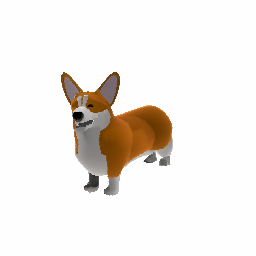
from PIL import Image# The four prompts we generate and benchmark on. Deliberately simple, compact,# single-object prompts - Shap-E falls apart on anything compositional.PROMPTS = ["a shark","a red sports car","a wooden chair","a birthday cupcake",]# Reference image for the image-conditioned path (section 10). In production this# image would come out of a text-to-image model (see 04_Text_to_Image); we cache a# stable one so the notebook does not need a second large model to run.REF_IMAGE = OUT_DIR /"corgi.png"ifnot REF_IMAGE.exists(): urllib.request.urlretrieve("https://hf.co/datasets/diffusers/docs-images/resolve/main/shap-e/corgi.png", REF_IMAGE, )ref_image = Image.open(REF_IMAGE).convert("RGB").resize((256, 256))print(ref_image.size)ref_image
(256, 256)
8. Shap-E: text-to-3D (openai/shap-e)
The only text-to-3D pipeline that is native to diffusers, and therefore the only one this notebook can honestly run. Architecture recap: a ~300M-parameter latent diffusion prior generates the weights of an implicit function (an MLP that maps a 3D coordinate to density + colour), and a “transmitter” decoder renders that function as a NeRF or marching-cubes it into a mesh. Because the latent is a shape, generation takes seconds, not the 30-90 minutes an SDS method needs.
Set expectations. By 2026 standards Shap-E’s output is bad: blobby, low-frequency, muddy colours, no fine detail, and it fails on anything compositional (“a cat wearing a hat riding a skateboard” produces mush). It is here because it is fast, small, MIT-licensed, and diffusers-native - a working end-to-end demonstration of the feed-forward paradigm, not a model you would ship. Everything above it in the section-6 table needs a vendor repo, a bigger card, or both.
Knobs: guidance_scale (15.0 is the documented default for text; higher = more prompt-faithful, more distorted), num_inference_steps (64 is the usual setting), frame_size (render resolution of the turntable frames - this only affects rendering cost, not shape quality).
from diffusers import ShapEPipelinefrom diffusers.utils import export_to_giffrom IPython.display import Image as IPyImage, displaypipe = ShapEPipeline.from_pretrained("openai/shap-e", torch_dtype=dtype, cache_dir=HF_CACHE,).to(device)prompt ="a shark"t0 = time.perf_counter()frames = pipe( prompt, guidance_scale=15.0, num_inference_steps=64, frame_size=256, # turntable render resolution).images[0] # -> a list of PIL frames orbiting the objectprint(f"{time.perf_counter() - t0:.1f}s for {len(frames)} rendered views")vram("shap-e loaded")gif_path = export_to_gif(frames, str(OUT_DIR /"shark.gif"))display(IPyImage(filename=gif_path))
The config attributes {'renderer': ['shap_e', 'ShapERenderer']} were passed to ShapEPipeline, but are not expected and will be ignored. Please verify your model_index.json configuration file.
Keyword arguments {'renderer': ['shap_e', 'ShapERenderer']} are not expected by ShapEPipeline and will be ignored.
An error occurred while trying to fetch /home/bthek1/Knowledge/DL/DL_tasks/datasets/hf_cache/models--openai--shap-e/snapshots/7bd337afdea1c17842e1c3cc45c4e268356dba40/prior: Error no file named diffusion_pytorch_model.safetensors found in directory /home/bthek1/Knowledge/DL/DL_tasks/datasets/hf_cache/models--openai--shap-e/snapshots/7bd337afdea1c17842e1c3cc45c4e268356dba40/prior.
Defaulting to unsafe serialization. Pass `allow_pickle=False` to raise an error instead.
An error occurred while trying to fetch /home/bthek1/Knowledge/DL/DL_tasks/datasets/hf_cache/models--openai--shap-e/snapshots/7bd337afdea1c17842e1c3cc45c4e268356dba40/shap_e_renderer: Error no file named diffusion_pytorch_model.safetensors found in directory /home/bthek1/Knowledge/DL/DL_tasks/datasets/hf_cache/models--openai--shap-e/snapshots/7bd337afdea1c17842e1c3cc45c4e268356dba40/shap_e_renderer.
Defaulting to unsafe serialization. Pass `allow_pickle=False` to raise an error instead.
# A static contact sheet of the turntable, so the rendered docs show something even# where the animated GIF does not play. (PIL for image display; ECharts is for charts.)def contact_sheet(views, cols=4, size=128):"Tile a list of PIL frames into a single strip/grid image." picks = views[:: max(1, len(views) // cols)][:cols] sheet = Image.new("RGB", (cols * size, size), "white")for i, im inenumerate(picks): sheet.paste(im.resize((size, size)), (i * size, 0))return sheetcontact_sheet(frames)
9. Shap-E: mesh export (the output that actually matters)
The GIF above is a NeRF turntable - pretty, and useless to a game engine. Pass output_type="mesh" and the transmitter runs marching cubes over the implicit field instead, giving a MeshDecoderOutput with .verts, .faces and per-vertex RGB in .vertex_channels. export_to_ply writes it to disk; trimesh converts it to a .glb.
This is where the honest critique of the whole pipeline lands. What comes out is a dense triangle soup with per-vertex colours: no UV map, no texture image, no PBR material set, no guaranteed manifoldness, and a poly count set by the marching-cubes resolution rather than by what the asset needs. Compare with the section-2 requirements - that is why Stable Fast 3D’s built-in UV unwrapping, and Hunyuan3D-Paint’s PBR maps, are the features that separate a research output from a shippable one.
We plot the vertices as a pyecharts Scatter3D, which is a legitimate use of ECharts: it is a scatter plot that happens to have three axes.
from diffusers.utils import export_to_plyfrom pyecharts import options as optsfrom pyecharts.charts import Scatter3Dt0 = time.perf_counter()mesh = pipe( prompt, guidance_scale=15.0, num_inference_steps=64, frame_size=256, output_type="mesh",).images[0]print(f"{time.perf_counter() - t0:.1f}s")verts = mesh.verts.detach().cpu().numpy()faces = mesh.faces.detach().cpu().numpy()print(f"{len(verts)} vertices / {len(faces)} triangles - no UVs, no material maps, per-vertex colour only")ply_path = export_to_ply(mesh, str(OUT_DIR /"shark.ply"))print("wrote", ply_path)# Convert to a glb a game engine or Blender can open (optional, needs trimesh):# import trimesh, numpy as np# m = trimesh.load(ply_path)# m.apply_transform(trimesh.transformations.rotation_matrix(-np.pi / 2, [1, 0, 0])) # Shap-E is bottom-up# m.export(str(OUT_DIR / "shark.glb"), file_type="glb")# Subsample for the browser - ECharts will not enjoy 30k points.step =max(1, len(verts) //4000)points = [[round(float(x), 4), round(float(z), 4), round(float(y), 4)] for x, y, z in verts[::step]]scatter = ( Scatter3D(init_opts=opts.InitOpts(width="760px", height="560px")) .add("vertices", points, grid3d_opts=opts.Grid3DOpts(width=100, height=100, depth=100), ) .set_series_opts(itemstyle_opts=opts.ItemStyleOpts(opacity=0.7)) .set_global_opts( title_opts=opts.TitleOpts(title=f"Shap-E mesh vertices: '{prompt}'", subtitle=f"{len(points)} of {len(verts)} vertices"), visualmap_opts=opts.VisualMapOpts( dimension=2, min_=float(min(p[2] for p in points)), max_=float(max(p[2] for p in points)), range_color=["#313695", "#4575b4", "#74add1", "#fee090", "#f46d43", "#a50026"], ), ))scatter.render_notebook()
9.1s
8970 vertices / 17932 triangles - no UVs, no material maps, per-vertex colour only
wrote ../../datasets/text_to_3d/shark.ply
10. The pipeline you would actually deploy: text -> image -> 3D
Section 3’s punchline, made concrete. Every strong 3D generator is image-conditioned, so real “text-to-3D” is a cascade:
Text -> image. Generate one clean reference view of the object with a good T2I model on a plain background (see 04_Text_to_Image; SDXL / SD 3.5 / FLUX all work, and a prompt suffix like “single object, centred, plain white background, product photo” matters more than the model choice).
Image -> 3D. Feed that image to an image-to-3D model. In production: TRELLIS.2 or Hunyuan3D on a 24 GB+ card. Here: openai/shap-e-img2img, the same architecture with a CLIP image embedding replacing the text embedding.
Why this beats text-conditioning directly: the T2I model has seen billions of images and knows what the object should look like; the 3D model has seen ~10M objects and mostly needs to know the shape. The reference image also gives you a cheap human checkpoint - if the render is wrong, regenerate the image, which takes seconds, instead of debugging the 3D stage.
Note the guidance scale drops to ~3.0 for the image path (an image embedding is a far stronger condition than a text embedding, so it needs much less pushing). 15_Image_to_3D owns the rest of this story - multi-view generation, LRM/triplane decoding, mesh extraction and texture baking.
# Free the text pipeline before loading the image one - never two models live at once.del pipe, meshfree_memory()vram("after shap-e text")from diffusers import ShapEImg2ImgPipelineimg_pipe = ShapEImg2ImgPipeline.from_pretrained("openai/shap-e-img2img", torch_dtype=dtype, cache_dir=HF_CACHE,).to(device)# Stage 1 (text -> image) would go here. We use the cached reference instead of loading# a second large model on a 12 GB card:## from diffusers import StableDiffusionXLPipeline# t2i = StableDiffusionXLPipeline.from_pretrained(# "stabilityai/stable-diffusion-xl-base-1.0", torch_dtype=dtype, cache_dir=HF_CACHE).to(device)# ref_image = t2i("a corgi, single object, centred, plain white background, product photo",# num_inference_steps=30).images[0].resize((256, 256))# del t2i; free_memory()t0 = time.perf_counter()img_frames = img_pipe( ref_image, guidance_scale=3.0, # much lower than text: the image embedding is a strong condition num_inference_steps=64, frame_size=256,).images[0]print(f"{time.perf_counter() - t0:.1f}s")display(IPyImage(filename=export_to_gif(img_frames, str(OUT_DIR /"corgi_3d.gif"))))del img_pipe, img_framesfree_memory()vram("after shap-e img2img")
VRAM after shap-e text 0.01 GB allocated / 0.02 GB reserved
The config attributes {'renderer': ['shap_e', 'ShapERenderer']} were passed to ShapEImg2ImgPipeline, but are not expected and will be ignored. Please verify your model_index.json configuration file.
Keyword arguments {'renderer': ['shap_e', 'ShapERenderer']} are not expected by ShapEImg2ImgPipeline and will be ignored.
An error occurred while trying to fetch /home/bthek1/Knowledge/DL/DL_tasks/datasets/hf_cache/models--openai--shap-e-img2img/snapshots/0e0aba80f08d368aaf6af9cb93583707481cc29b/prior: Error no file named diffusion_pytorch_model.safetensors found in directory /home/bthek1/Knowledge/DL/DL_tasks/datasets/hf_cache/models--openai--shap-e-img2img/snapshots/0e0aba80f08d368aaf6af9cb93583707481cc29b/prior.
Defaulting to unsafe serialization. Pass `allow_pickle=False` to raise an error instead.
An error occurred while trying to fetch /home/bthek1/Knowledge/DL/DL_tasks/datasets/hf_cache/models--openai--shap-e-img2img/snapshots/0e0aba80f08d368aaf6af9cb93583707481cc29b/shap_e_renderer: Error no file named diffusion_pytorch_model.safetensors found in directory /home/bthek1/Knowledge/DL/DL_tasks/datasets/hf_cache/models--openai--shap-e-img2img/snapshots/0e0aba80f08d368aaf6af9cb93583707481cc29b/shap_e_renderer.
Defaulting to unsafe serialization. Pass `allow_pickle=False` to raise an error instead.
What this is not. A real text-to-3D benchmark would compare TRELLIS.2, Hunyuan3D, TripoSG and the commercial APIs on human preference. None of them run on a 12 GB card through diffusers, so that comparison is not available here, and pretending otherwise would be dishonest. For the real ranking go to 3DGen-Arena and 3D Arena.
What this is. A sweep of Shap-E’s own knobs - num_inference_steps and guidance_scale - over 4 prompts, measuring seconds per asset and CLIP score + R-Precision on the rendered views. That is a genuinely useful thing to know (it tells you where the compute/quality knee is for the one model you can run), and it demonstrates the standard text-to-3D metric end to end. It measures Shap-E, not the state of the art.
Protocol: 4 prompts x 4 configs = 16 generations at frame_size=128. R-Precision uses the other three prompts as distractors (a 4-way retrieval, so chance = 0.25). Hardware: RTX 3060 12 GB. Sample size 4 - a smoke test, not a leaderboard.
import pandas as pdCONFIGS = [ ("steps=16, cfg=15", 16, 15.0), ("steps=32, cfg=15", 32, 15.0), ("steps=64, cfg=15", 64, 15.0), # the documented default ("steps=64, cfg=5", 64, 5.0), # under-guided: prettier, less faithful]N_VIEWS =4# views handed to CLIP per assetpipe = ShapEPipeline.from_pretrained("openai/shap-e", torch_dtype=dtype, cache_dir=HF_CACHE,).to(device)renders, timings = {}, {}for label, steps, cfg in CONFIGS:for p in PROMPTS: t0 = time.perf_counter() views = pipe(p, guidance_scale=cfg, num_inference_steps=steps, frame_size=128).images[0] timings[(label, p)] = time.perf_counter() - t0# Keep only N_VIEWS evenly-spaced frames - the rest is RAM we do not need. renders[(label, p)] = views[:: max(1, len(views) // N_VIEWS)][:N_VIEWS]print(f"{label:18s}{sum(timings[(label, p)] for p in PROMPTS) /len(PROMPTS):5.1f} s/asset")# Generation done - free Shap-E BEFORE loading CLIP, so only one model is ever live.del pipefree_memory()vram("after generation")
The config attributes {'renderer': ['shap_e', 'ShapERenderer']} were passed to ShapEPipeline, but are not expected and will be ignored. Please verify your model_index.json configuration file.
Keyword arguments {'renderer': ['shap_e', 'ShapERenderer']} are not expected by ShapEPipeline and will be ignored.
An error occurred while trying to fetch /home/bthek1/Knowledge/DL/DL_tasks/datasets/hf_cache/models--openai--shap-e/snapshots/7bd337afdea1c17842e1c3cc45c4e268356dba40/prior: Error no file named diffusion_pytorch_model.safetensors found in directory /home/bthek1/Knowledge/DL/DL_tasks/datasets/hf_cache/models--openai--shap-e/snapshots/7bd337afdea1c17842e1c3cc45c4e268356dba40/prior.
Defaulting to unsafe serialization. Pass `allow_pickle=False` to raise an error instead.
An error occurred while trying to fetch /home/bthek1/Knowledge/DL/DL_tasks/datasets/hf_cache/models--openai--shap-e/snapshots/7bd337afdea1c17842e1c3cc45c4e268356dba40/shap_e_renderer: Error no file named diffusion_pytorch_model.safetensors found in directory /home/bthek1/Knowledge/DL/DL_tasks/datasets/hf_cache/models--openai--shap-e/snapshots/7bd337afdea1c17842e1c3cc45c4e268356dba40/shap_e_renderer.
Defaulting to unsafe serialization. Pass `allow_pickle=False` to raise an error instead.
VRAM after clip 0.01 GB allocated / 0.02 GB reserved
config
clip
r_prec
seconds
0
steps=16, cfg=15
30.992
1.0
8.414
1
steps=32, cfg=15
30.960
1.0
10.704
2
steps=64, cfg=15
30.978
1.0
15.266
3
steps=64, cfg=5
30.783
1.0
15.277
from pyecharts.charts import Bar, Scatterbar = ( Bar(init_opts=opts.InitOpts(width="820px", height="420px")) .add_xaxis(summary["config"].tolist()) .add_yaxis("mean CLIP score", [round(float(v), 2) for v in summary["clip"]]) .add_yaxis("R-Precision x 30 (chance = 7.5)", [round(float(v) *30, 2) for v in summary["r_prec"]]) .set_global_opts( title_opts=opts.TitleOpts(title="Shap-E: prompt fidelity vs sampling knobs", subtitle="CLIP ViT-B/32 over 4 rendered views, 4 prompts (RTX 3060). R-Precision rescaled to share the axis."), xaxis_opts=opts.AxisOpts(name="config"), yaxis_opts=opts.AxisOpts(name="score"), tooltip_opts=opts.TooltipOpts(trigger="axis"), ))bar.render_notebook()
scatter2d = Scatter(init_opts=opts.InitOpts(width="820px", height="440px"))scatter2d.add_xaxis([round(float(s), 1) for s in summary["seconds"]])for _, r in summary.iterrows(): scatter2d.add_yaxis( r["config"], [[round(float(r["seconds"]), 1), round(float(r["clip"]), 2)]], symbol_size=18, label_opts=opts.LabelOpts(is_show=False), )scatter2d.set_global_opts( title_opts=opts.TitleOpts(title="Quality vs time (Shap-E only)", subtitle="Up and to the left is better. Every point here would be a single dot far to the bottom-left of TRELLIS.2."), xaxis_opts=opts.AxisOpts(name="seconds / asset", type_="value"), yaxis_opts=opts.AxisOpts(name="mean CLIP score", type_="value", min_="dataMin", max_="dataMax"), tooltip_opts=opts.TooltipOpts(trigger="item"),)scatter2d.render_notebook()# Read this honestly: CLIP score barely moves with steps, because CLIP is scoring 2-D# renders and Shap-E's blobs are already "shark-shaped enough" at 16 steps. The metric# is not seeing the geometry improve. That is section 4's blind spot, measured.
12. Interactive: your own prompt
Type a prompt and get a turntable. Guarded so a headless/non-interactive run (Quarto render, CI) falls back to a default instead of hanging on input(). Keep prompts to a single concrete object - Shap-E has no compositional ability whatsoever.
The config attributes {'renderer': ['shap_e', 'ShapERenderer']} were passed to ShapEPipeline, but are not expected and will be ignored. Please verify your model_index.json configuration file.
Keyword arguments {'renderer': ['shap_e', 'ShapERenderer']} are not expected by ShapEPipeline and will be ignored.
An error occurred while trying to fetch /home/bthek1/Knowledge/DL/DL_tasks/datasets/hf_cache/models--openai--shap-e/snapshots/7bd337afdea1c17842e1c3cc45c4e268356dba40/prior: Error no file named diffusion_pytorch_model.safetensors found in directory /home/bthek1/Knowledge/DL/DL_tasks/datasets/hf_cache/models--openai--shap-e/snapshots/7bd337afdea1c17842e1c3cc45c4e268356dba40/prior.
Defaulting to unsafe serialization. Pass `allow_pickle=False` to raise an error instead.
An error occurred while trying to fetch /home/bthek1/Knowledge/DL/DL_tasks/datasets/hf_cache/models--openai--shap-e/snapshots/7bd337afdea1c17842e1c3cc45c4e268356dba40/shap_e_renderer: Error no file named diffusion_pytorch_model.safetensors found in directory /home/bthek1/Knowledge/DL/DL_tasks/datasets/hf_cache/models--openai--shap-e/snapshots/7bd337afdea1c17842e1c3cc45c4e268356dba40/shap_e_renderer.
Defaulting to unsafe serialization. Pass `allow_pickle=False` to raise an error instead.
34.0s
<IPython.core.display.Image object>
VRAM final 0.01 GB allocated / 0.02 GB reserved
13. Common Frameworks
Text-to-3D is the least library-native task in this folder. There is no diffusers pipeline family for the current state of the art, so the modelling layer is a set of vendor repos that each want their own environment. The other half of the ecosystem is not machine learning at all: generating a shape is perhaps half the work, and turning that shape into an asset an artist or an engine will accept is the rest.
Long-running async jobs with progress, because a single asset takes minutes and a queue is the only sane interface
Apache 2.0
Serving generation. Nothing here is interactive
CLIP/CLIP-R-precision + human review
evaluation
Multi-view renders scored against the prompt, plus the manifoldness and poly-count checks that decide usability
Apache 2.0
Always. There is no FID for meshes, and the metrics that exist do not measure whether an artist will accept the result
The 2026 default stack is text-to-image with a model you can steer, then a vendor image-to-3D model (TRELLIS.2 or Hunyuan3D) on a bigger card, then trimesh plus Blender for post-processing. Shap-E is here to make the pipeline legible, not because anyone ships it.
The common wrong turn is judging the model by its render. A turntable video hides non-manifold geometry, inverted normals, 200k triangles where 5k are needed, and baked-in lighting - all of which make the mesh unusable regardless of how it looks. Check the geometry, not the picture. The second is expecting a scene: everything here generates a single centred object, and text-to-scene remains a substantially harder open problem.
14. Going Further
Run the real thing. The two-stage route: text -> image with SDXL/FLUX (04_Text_to_Image), then a vendor image-to-3D model on a 24 GB+ card. Which ones, and what they cost, are in the frameworks table above. Watch the diffusers changelog - a native 3D pipeline family is the obvious next addition.
Fix the mesh, which is most of the work. Nothing above emits a shippable asset. The post-process is: decimate / retopologise (Blender’s Decimate, Instant Meshes, quadriflow), UV unwrap (xatlas), bake albedo/normal/roughness maps, check manifoldness (trimesh.is_watertight, is_winding_consistent), and fix scale. This is what you pay Meshy/Tripo/Rodin for.
SDS, if you have time to burn.threestudio is the reference implementation of DreamFusion, Magic3D, ProlificDreamer, Fantasia3D and MVDream under one config system. Still the way to get maximum fidelity on a single asset when 40 minutes of GPU is acceptable.
Fine-tuning. Nobody fine-tunes text-to-3D end to end on a small budget. The practical lever is to fine-tune (or LoRA) the 2-D stage on your art style, then feed the resulting images to a frozen image-to-3D model - the style transfers, the geometry model stays generic.
Scenes, not objects. Everything here generates a single centred object. Text-to-scene (layout, multiple objects, a floor) is a separate and much less solved problem; 3D Gaussian Splatting scene generation is the active line.