Everything to know about generating images from text: latent diffusion and flow matching, the mid-2026 model landscape, evaluation metrics that actually predict human preference, and runnable code to test the leading open models on a 12 GB card.
Author
Benedict Thekkel
1. What is Text-to-Image?
Text-to-image (T2I) maps a natural-language prompt to a synthetic image. There is no input image and no ground truth output - the model samples from a conditional distribution p(image | prompt), so the same prompt with a different random seed gives a different (equally valid) picture.
Input. A prompt string, tokenized and pushed through one or more frozen text encoders (CLIP text towers, T5-XXL, or in 2025-2026 a full VLM/LLM such as Qwen2.5-VL or Gemma). The result is a sequence of text embeddings, not a single vector - cross-attention (or joint attention) lets each image patch look at each word. Optional extra inputs:
Negative prompt - a second conditioning string the sampler is pushed away from (section 8).
Seed - fixes the initial Gaussian noise, so generation is reproducible.
Output. An RGB image, almost always produced by decoding a low-resolution latent through a VAE decoder rather than predicting pixels directly (section 3). Typical native resolutions: 512x512 (SD 1.5), 1024x1024 (SDXL, SD 3.5, PixArt-Sigma, SANA), up to 4 MP (FLUX.2).
Neighbouring tasks (usually the same backbone, different conditioning):
Task
What it does
Typical tool
Notebook
Image-to-image / inpainting / editing
Edit an existing image, keep its structure
SDXL img2img, FLUX.2 Kontext, Qwen-Image-Edit
06_Image_to_Image
Structure-conditioned generation
Generate from a pose/depth/edge map
ControlNet, T2I-Adapter
06_Image_to_Image
Unconditional generation
Sample images with no prompt at all
DDPM, plain latent diffusion
08_Unconditional_Image_Generation
Image-to-text (captioning)
The inverse mapping
BLIP-2, Qwen2.5-VL
05_Image_to_Text
Text-to-video
Same recipe, plus a time axis
Wan, LTX-Video, Mochi
10_Text_to_Video
Text-to-3D
Same recipe, plus a 3D representation
TRELLIS, SDS-based methods
14_Text_to_3D
Read this notebook first: 06_Image_to_Image and 10_Text_to_Video are the same machine (VAE + denoiser + text encoder + sampler) with an extra conditioning signal bolted on.
2. Real-World Use Cases
T2I is the most commercially deployed generative-vision task, and the deployments pull the model in opposite directions: a game studio wants one perfect 4K hero asset in five minutes, a marketplace wants ten million passable thumbnails overnight for a tenth of a cent each.
Latency (users abandon past ~10 s); safety filtering at scale; multi-turn consistency
Synthetic training data
CV/robotics research
Prompt + layout -> labelled synthetic images
Diversity and label fidelity, not beauty; must not collapse to a mode
Architecture, interiors, fashion
Design tools (Vizcom, Spline)
Sketch + material prompt -> render
Structural fidelity to the sketch (ControlNet), not free-form creativity
Personalisation / avatars
Consumer (Lensa-style, Meta AI stickers)
5-20 selfies + prompt -> stylised portraits
Identity preservation (LoRA/IP-Adapter); on-device or cheap fine-tuning; heavy abuse surface
What the Arena Elo hides. A leaderboard rank is an average aesthetic preference on generic prompts, and almost none of the things that sink a real deployment show up in it. Prompt adherence collapses on compositional prompts - counting (“five red apples”), spatial relations (“the cup behind the book”), attribute binding (“a red cube and a blue sphere”, where models happily swap the colours) and negation. Text rendering was the single biggest differentiator of 2024-2026; a model that cannot spell is unusable for ads regardless of its Elo. Latency and cost are architectural: a 50-step 20B MMDiT and a 1-step distilled 0.6B model are both “text-to-image” and differ by ~1000x in cost per image, so the product decides the model, not the leaderboard. Determinism matters more than people expect - a marketing pipeline needs the same seed + prompt to give the same asset next quarter, which pins you to a model version forever. And the production failure modes are the ugly ones: anatomy (hands, teeth, limb count), style leakage toward a training-set artist, memorisation of near-duplicate training images, NSFW and celebrity-likeness escapes past the safety checker, and demographic collapse (“a CEO” returning the same person 90% of the time). Finally, the licence is a deployment constraint, not a footnote: FLUX.1 [dev] and FLUX.2 [dev] weights are non-commercial, and SDXL-Turbo is research-only, so half the “best open models” cannot legally ship in the product you are building.
3. How Modern Text-to-Image Works
3.1 The latent diffusion recipe
Every open model below (and almost every closed one) is the same four-part machine, introduced by Latent Diffusion / Stable Diffusion (Rombach et al., CVPR 2022):
VAE encoder - compresses a 1024x1024x3 image into a small latent, e.g. 128x128x4 (SD/SDXL, 8x spatial compression, 48x fewer numbers) or 32x32x32 for SANA’s deep-compression autoencoder. Diffusion runs in this latent space - that single trick is what made T2I affordable.
Text encoder(s) - frozen. CLIP-L (SD 1.5), CLIP-L + OpenCLIP-G (SDXL), + T5-XXL (SD 3, FLUX.1, PixArt), or a full VLM/LLM (Qwen2.5-VL-7B for Qwen-Image, Gemma-2 for SANA, Mistral-Small for FLUX.2).
Denoiser - the only trained-from-scratch part, and where all the parameters live: a U-Net (SD 1.5, SDXL) or a DiT / MMDiT transformer (SD 3.5, PixArt, FLUX, Qwen-Image, SANA).
VAE decoder - latent back to pixels. Also the source of a whole class of artifacts (colour shift, high-frequency mush) that people wrongly blame on the denoiser.
3.2 Forward and reverse diffusion
Forward (training, no learning): take a clean latent x_0 and progressively destroy it with Gaussian noise. In closed form, for a noise schedule with cumulative alpha abar_t,
That is the whole loss. No adversarial game, no likelihood bound in practice - just a regression onto noise, which is why diffusion trains so stably compared to GANs.
Reverse (sampling): start from pure noise x_T ~ N(0, I) and iteratively subtract the predicted noise, stepping t from T down to 0. Each step is one full forward pass of the denoiser - hence step count is the main speed knob and the dominant term in cost.
3.3 Classifier-free guidance (CFG)
The single most important sampling knob. At each step, run the denoiser twice - once conditioned on the prompt, once on the empty (or negative) prompt - and extrapolate away from the unconditional prediction:
\[\hat{\epsilon} = \epsilon_\theta(x_t, t, \varnothing) + w \cdot \big( \epsilon_\theta(x_t, t, c) - \epsilon_\theta(x_t, t, \varnothing) \big)\]
w is the guidance scale. What it actually trades:
w = 1 - no guidance. Faithful to the learned distribution: diverse, but often ignores the prompt.
w = 5-8 - the usual band for SD/SDXL. Strong prompt adherence.
w > 12 - oversaturated colours, burnt highlights, blown-out contrast, mode collapse toward a single “prompt-y” composition. Higher guidance is not “more correct” - it is a sharper, less diverse, more artefact-prone sample.
Note the cost: CFG doubles the compute per step, because you evaluate the denoiser twice. Two escapes exist, both used by modern models: guidance distillation (train a student to imitate the CFG output in one pass - FLUX.1 [schnell]/[dev], SANA-Sprint do this, which is why they take a guidance_scale argument that is embedded, not a real double pass) and CFG-free / distilled few-step models where guidance is baked in.
The negative prompt is just the unconditional branch with content in it: instead of varnothing you pass “blurry, watermark, extra fingers”, so the sampler is actively pushed away from that region. It only exists when real CFG is running - a distilled model at guidance_scale=0.0 (SDXL-Turbo) cannot use a negative prompt at all.
3.4 Samplers / schedulers
The reverse process is an ODE/SDE; the sampler is the numerical integrator. The choice changes quality-per-step far more than most people realise, and costs nothing to swap.
Sampler
Year
Steps for good output
Notes
DDPM (ancestral)
2020
1000
The original. Stochastic, unusably slow.
DDIM
2021
50
Deterministic, made diffusion practical. Same seed -> same image.
Euler / Euler-a
2022
20-30
Simple, robust, the k-diffusion default. -a is ancestral (adds noise, never fully converges).
DPM-Solver++ (2M, Karras sigmas)
2022-23
15-25
Higher-order multistep ODE solver. Best quality/step for U-Net models - a strict upgrade over DDIM, free.
FlowMatchEulerDiscrete
2024
20-30
The rectified-flow sampler (SD 3, FLUX, SANA). Straight paths, so Euler is enough.
LCM / TCD / SCM (consistency)
2023-25
1-4
Not integrators - distilled jump solvers. See 3.6.
Rule of thumb: on a U-Net model, switch to DPM-Solver++ 2M with Karras sigmas and drop from 50 steps to 20 for free. Beyond ~30 steps, more steps buy essentially nothing.
Two independent changes landed at once, and together they are why 2026 models need 20 steps where 2022 models needed 50.
Architecture.DiT (Peebles and Xie, 2022) replaced the convolutional U-Net with a plain transformer over latent patches - it scales cleanly with parameters and data, which the U-Net did not. PixArt-alpha/Sigma (2023-24) proved a 0.6B DiT could match SDXL’s 2.6B U-Net at a fraction of the training cost. MMDiT (SD 3, March 2024) went further: instead of the image stream cross-attending into frozen text, image and text tokens are concatenated into one sequence with separate weights per modality and joint attention, so text representations are updated by the image and vice versa. That is the change that finally fixed spelling and attribute binding. FLUX.1 (Aug 2024), FLUX.2 (Nov 2025), Qwen-Image (2025) and HiDream all use MMDiT-style double-stream blocks.
Objective.Rectified flow / flow matching (2022-23, mainstream from SD 3) replaces the curved DDPM noise schedule with a straight line between noise and data: x_t = (1-t) x_0 + t * epsilon, and the network predicts the constant velocity v = epsilon - x_0. Because the true trajectory is (nearly) straight, a first-order Euler step is accurate over a long interval - so fewer steps are needed, and the model distills to 1-4 steps much more easily than a DDPM-schedule model. Every 2025-2026 flagship is a rectified-flow model.
3.6 Distillation: 1-4 step generation
The last piece. A teacher that takes 50 CFG’d steps (= 100 forward passes) is distilled into a student that takes 1-4:
LCM / LCM-LoRA (Oct 2023) - latent consistency models: learn a map from any point on the trajectory straight to the endpoint. Shipped as a LoRA you can bolt onto any SD/SDXL checkpoint, 4-8 steps.
SDXL-Turbo / SD-Turbo (Nov 2023) - Adversarial Diffusion Distillation (ADD): consistency distillation plus a discriminator to restore the sharpness that pure distillation loses. 1-4 steps, guidance_scale=0.0. Research-only licence.
SDXL-Lightning (ByteDance, Feb 2024) - progressive adversarial distillation, 1/2/4/8-step UNets and LoRAs, quality noticeably above Turbo at 4 steps. Apache-2.0-adjacent (OpenRAIL++).
FLUX.1 [schnell] (Aug 2024) - latent adversarial diffusion distillation of a 12B rectified-flow MMDiT, 1-4 steps, Apache 2.0 (the only genuinely permissive model of that class for a long time).
SANA-Sprint (NVIDIA/MIT, Mar 2025) - continuous-time consistency distillation (sCM) + latent adversarial distillation on a linear-attention DiT. 7.59 FID / 0.74 GenEval in one step, beating FLUX-schnell (7.94 / 0.71) while being ~10x faster; 0.31 s per 1024px image on an RTX 4090.
FLUX.2 [klein] (Jan 2026) - 4B (Apache 2.0) and 9B (non-commercial) size-distilled + step-distilled students of FLUX.2, sub-second on consumer GPUs at 4 steps.
The price of distillation is diversity: a 1-step student maps each noise sample to essentially one image, so seed-to-seed variety and fine prompt nuance shrink. Distilled models are for throughput and interactivity, not for the best possible single image.
Cheat sheet:
Generation
Denoiser
Objective
Steps
Text encoder
Example
2022
U-Net
DDPM eps-pred
50
CLIP-L
SD 1.5
2023
U-Net (bigger)
DDPM eps-pred
30-50
CLIP-L + CLIP-G
SDXL
2023-24
DiT
DDPM eps-pred
20
T5-XXL
PixArt-Sigma
2024-25
MMDiT
rectified flow
20-28
CLIP x2 + T5
SD 3.5, FLUX.1
2025-26
MMDiT (+ VLM encoder)
rectified flow
20-50
Qwen2.5-VL / Mistral
Qwen-Image, FLUX.2
2024-26 (fast lane)
any of the above, distilled
consistency / adversarial
1-4
as above
SDXL-Turbo, schnell, SANA-Sprint, klein
Who leads in mid-2026? MMDiT + rectified flow + a VLM text encoder, scaled to 4-32B, and then distilled for serving. Nothing else is competitive at the top, and the interesting engineering question has moved from “which architecture” to “how few steps and how much quantization can I get away with”.
4. Evaluation Metrics
T2I evaluation is genuinely unsolved, and the number people quote is usually the wrong one.
4.1 FID (Frechet Inception Distance)
The historical default. Push N real images and N generated images through an Inception-v3 pool3 layer (2048-d), fit a Gaussian to each set, and take the Frechet (2-Wasserstein) distance between them:
Lower is better. The standard protocol is FID-30k on COCO 2014 validation captions at 256x256.
The caveats are severe, and you should treat FID as a smoke alarm, not a judge:
It measures distribution match, not per-image quality. A model that produces 30k mediocre-but-varied images beats one that produces 30k gorgeous images in a narrower style.
It is biased at small N. FID is not an unbiased estimator; N=1k and N=30k are not comparable, ever. It is also extremely sensitive to the resizing/JPEG pipeline (bilinear vs Lanczos, PIL vs TF) - papers have differed by 2 FID points from resizing alone.
It is anchored to a 2015 ImageNet classifier, whose features have very little to do with what a human finds beautiful or on-prompt.
Turning guidance up improves human preference and worsens FID. That fact alone should end its use as a quality ranking: FID is a poor guide to what people prefer.
4.2 CLIPScore (prompt adherence)
Cosine similarity between the CLIP image embedding and the CLIP text embedding of the prompt, rescaled:
\[\mathrm{CLIPScore}(I, T) = w \cdot \max\!\left( \cos\!\left( E_I(I),\, E_T(T) \right),\, 0 \right), \qquad w = 2.5\]
Measures did you draw what I asked, and says nothing about quality. It saturates fast, is blind to counting and spatial relations, and can be gamed by drawing the words. Typical values with ViT-L/14 land in the 0.25-0.35 raw-cosine band (0.6-0.9 after the 2.5x rescale).
4.3 What actually ranks models in 2026
Human/model preference scores trained on real human picks: PickScore (Pick-a-Pic), HPSv2/v3 (Human Preference Score), ImageReward. These correlate with human choice far better than FID or CLIPScore and are what fine-tuning (DPO/GRPO on diffusion) optimises against.
Compositional benchmarks: GenEval (object-focused: counting, colour, position, attribute binding; the de-facto number in every 2025-26 model card, ~0.7-0.9 for current SOTA) and T2I-CompBench++ (8k compositional prompts). GenEval 2 (Dec 2025) exists precisely because the original saturated. VQAScore (ask a VLM “does this image show X?”) correlates with humans better than CLIPScore on compositional prompts.
Arena Elo - the real ranking. Blind pairwise human votes: the Artificial Analysis Text-to-Image Arena and the LMArena text-to-image leaderboard. As of mid-2026 the arena is topped by closed models (GPT Image 2, Reve 2.0, MAI-Image-2.5, Nano Banana 2 / Gemini 3 Flash Image), with the best open-weights entries (Cosmos3-Super-Text2Image, HiDream-O1, Qwen-Image, FLUX.2) roughly 60-120 Elo behind.
Speed metrics that matter as much as any of the above: seconds per image at a fixed resolution and step count, steps (the real cost driver), peak VRAM, and images/second at batch size 1 (interactive) vs 8 (bulk).
The toy cell below computes FID on fabricated feature arrays (so the shape of the formula is concrete) and a real CLIPScore with transformers CLIP on two synthetic images.
# Metric toys - no image model needed. FID from the formula, CLIPScore from CLIP.from pathlib import Pathimport numpy as npimport torchfrom PIL import Imagefrom scipy import linalgfrom transformers import CLIPModel, CLIPProcessor# ---- FID on fabricated Inception features -------------------------------------rng = np.random.default_rng(0)D, N =2048, 500# Inception pool3 is 2048-d; N=500 is far too few for a real FIDreal = rng.normal(loc=0.0, scale=1.0, size=(N, D)) # "real" featuresgen_close = real + rng.normal(0, 0.30, size=(N, D)) # a good generatorgen_far = rng.normal(loc=0.6, scale=1.4, size=(N, D)) # a bad / mode-shifted onedef fid(feats_a, feats_b, eps=1e-6):"Frechet distance between two Gaussians fitted to the feature sets." mu_a, mu_b = feats_a.mean(0), feats_b.mean(0) sig_a, sig_b = np.cov(feats_a, rowvar=False), np.cov(feats_b, rowvar=False) diff = mu_a - mu_b# sqrtm of a product of covariances; add eps*I for numerical stability covmean = linalg.sqrtm(sig_a.dot(sig_b)) # scipy >= 1.16: disp/errest are deprecatedifnot np.isfinite(covmean).all(): offset = np.eye(sig_a.shape[0]) * eps covmean = linalg.sqrtm((sig_a + offset).dot(sig_b + offset)) covmean = covmean.real # numerical noise leaves a tiny imaginary partreturnfloat(diff.dot(diff) + np.trace(sig_a + sig_b -2.0* covmean))print(f"FID(real, gen_close) = {fid(real, gen_close):8.2f} <- similar distribution")print(f"FID(real, gen_far) = {fid(real, gen_far):8.2f} <- shifted mean + variance")print(f"FID(real, real) = {fid(real, real):8.2f} <- not exactly 0: N={N} is tiny, FID is biased at small N")# ---- CLIPScore on two synthetic images ----------------------------------------# The reference implementation uses ViT-L/14; ViT-B/32 is 30x cheaper and fine for a demo._dev ="cuda:0"if torch.cuda.is_available() else"cpu"_cache =str(Path("../../datasets") /"hf_cache")clip_id ="openai/clip-vit-base-patch32"try:# Cached-first: skip the Hub HEAD check, which hangs in a retry loop when the# Hub is down (504) even though the weights are already on disk. clip = CLIPModel.from_pretrained(clip_id, cache_dir=_cache, local_files_only=True) clip_proc = CLIPProcessor.from_pretrained(clip_id, cache_dir=_cache, local_files_only=True)exceptOSError: # first run on this machine - actually download clip = CLIPModel.from_pretrained(clip_id, cache_dir=_cache) clip_proc = CLIPProcessor.from_pretrained(clip_id, cache_dir=_cache)clip = clip.to(_dev).eval()def clip_score(images, prompts, w=2.5):"CLIPScore = w * max(cos(E_I, E_T), 0), computed pairwise for images[i] vs prompts[i]." inputs = clip_proc(text=prompts, images=images, return_tensors="pt", padding=True).to(_dev)with torch.inference_mode(): img_e = clip.get_image_features(pixel_values=inputs["pixel_values"]).pooler_output txt_e = clip.get_text_features(input_ids=inputs["input_ids"], attention_mask=inputs["attention_mask"]).pooler_output img_e = img_e / img_e.norm(dim=-1, keepdim=True) txt_e = txt_e / txt_e.norm(dim=-1, keepdim=True) cos = (img_e * txt_e).sum(-1) # pairwise, not the full matrixreturn (w * cos.clamp(min=0)).cpu().tolist()red = Image.new("RGB", (224, 224), (220, 30, 30))blue = Image.new("RGB", (224, 224), (30, 60, 220))prompts = ["a solid red square", "a solid blue square"]print("matched :", [round(s, 3) for s in clip_score([red, blue], prompts)])print("swapped :", [round(s, 3) for s in clip_score([blue, red], prompts)])# Matched pairs score higher - but note how small the gap is. CLIPScore is a weak,# saturating signal: it cannot count, cannot do spatial relations, and a 0.02 gap# between two real models is noise, not a ranking.
FID(real, gen_close) =   161.79   <- similar distribution
FID(real, gen_far)   =  4462.74   <- shifted mean + variance
FID(real, real)      =    -0.00   <- not exactly 0: N=500 is tiny, FID is biased at small N
matched  : [0.72, 0.733]
swapped  : [0.627, 0.591]
5. Datasets
T2I models are trained on web-scale image + alt-text pairs. Nobody trains on clean human captions at this scale - the captions are scraped alt-text, then usually re-captioned by a VLM (the single biggest data-quality win of 2023-2026: DALL-E 3’s “recaptioning” paper, then everyone).
The LAION story is a required caveat. In December 2023 the Stanford Internet Observatory found ~3,200 suspected CSAM links (1,008 externally validated) inside LAION-5B. LAION pulled the dataset entirely, and in August 2024 re-released it as Re-LAION-5B with 2,236 links removed, in partnership with the IWF, C3P and SIO. Every SD 1.5 / SD 2.x / SDXL checkpoint in the wild was trained on the pre-cleanup data. That is not a footnote - it is the central fact in the ongoing lawsuits and in why the “indemnified” commercial models (Adobe Firefly, Getty) advertise licensed-only corpora. It is also why you should not casually train on a raw web scrape today.
Evaluation prompt sets
There is no “test split” - you evaluate on prompt sets:
Object-focused, auto-graded with an object detector; the standard 2025-26 number
This notebook evaluates on a small hand-picked subset of PartiPrompts (loaded from the Hub, with an inline fallback) plus a couple of deliberately hard compositional prompts, scored with CLIPScore and wall-clock. That is a smoke test - see the benchmark caveat in section 13.
Who wins what. - Quality / prompt adherence: closed models, then FLUX.2 [dev], Qwen-Image, HiDream. None of them fit here. - Text-in-image: Qwen-Image, then FLUX.2, then SD 3.5. Anything CLIP-only (SD 1.5, SDXL) cannot spell. - Speed: SANA-Sprint (sub-second at 1024px on a 4090; 1-2 steps), then FLUX.2 [klein], SDXL-Turbo/Lightning. - Licence you can actually ship: FLUX.1 [schnell] and FLUX.2 [klein] 4B (Apache 2.0), Qwen-Image (Apache 2.0), SDXL/SDXL-Lightning (OpenRAIL++). Not FLUX [dev], SDXL-Turbo, or SANA’s non-commercial weights.
The 12 GB reality. The RTX 3060 in this box has 12 GB, and the box itself has 12 GB of RAM. That rules out fp16 FLUX (24 GB), Qwen-Image (40 GB), HiDream and FLUX.2 [dev] outright. It leaves: SD 1.5, SDXL (+ Turbo/Lightning), SD 3.5 Medium (with T5 dropped), PixArt-Sigma (with offload), SANA/SANA-Sprint - all comfortable - and FLUX.1 [schnell] / FLUX.2 [klein] 4B only under 4-bit quantization + CPU offload (section 12). Every runnable cell below uses torch.float16 (or bfloat16 where the model demands it), enable_model_cpu_offload(), and VAE slicing/tiling.
7. Setup
Package roles:
diffusers - the general-purpose HF library for diffusion pipelines. Not a vendor package: it hosts SD, SDXL, SD3, PixArt, SANA, FLUX, Qwen-Image behind one API, exactly as transformers does for LLMs.
transformers - the frozen text encoders inside every pipeline (CLIP, T5, Gemma-2, Qwen2.5-VL), and the CLIP we use for CLIPScore.
torch, accelerate - execution and enable_model_cpu_offload() / device_map placement.
bitsandbytes - 4-bit/8-bit weights, the only way FLUX-class models touch this card (section 12).
sentencepiece, protobuf - T5/Gemma tokenizers.
datasets - the PartiPrompts eval prompts.
scipy - sqrtm for the FID toy; pyecharts + pandas for the benchmark charts.
Three memory rules apply to every cell below and are not optional on this box:
torch_dtype=torch.float16 (or bfloat16 for SANA / SD 3.5 - Ampere and later only).
pipe.enable_model_cpu_offload() instead of pipe.to(device) - it keeps only the currently executing submodule on the GPU and parks the text encoder / VAE in RAM. Costs a little latency, saves several GB.
pipe.vae.enable_slicing() and enable_tiling() - VAE decode of a 1024px image is a surprisingly large activation spike; slicing/tiling flattens it.
And after every model: del pipe; free_memory(); vram("after X"). Never hold two pipelines live.
# diffusers is the general-purpose HF library for image generation (same ecosystem as# transformers) - no vendor/per-model packages anywhere in this notebook.# %pip install -q torch diffusers transformers accelerate datasets safetensors# %pip install -q sentencepiece protobuf scipy pandas pyecharts# Only needed for section 12 (4-bit FLUX on a 12 GB card)# %pip install -q bitsandbytes
import ctypesimport ctypes.utilimport gcimport timefrom pathlib import Pathimport torchfrom dotenv import find_dotenv, load_dotenv# Knowledge/.env sets HF_TOKEN - authenticated HF Hub requests get higher rate limits,# and SD 3.5 Medium is a *gated* repo (accept its licence on the Hub first).load_dotenv(find_dotenv(usecwd=True))device ="cuda:0"if torch.cuda.is_available() else"cpu"dtype = torch.float16 if device !="cpu"else torch.float32if device !="cpu":print(torch.cuda.get_device_name(0))print(f"total VRAM: {torch.cuda.get_device_properties(0).total_memory /1e9:.1f} GB")print("device:", device)def vram(tag=""):"Report current GPU memory (allocated / reserved). No-op on CPU."if torch.cuda.is_available(): alloc = torch.cuda.memory_allocated() /1e9 reserved = torch.cuda.memory_reserved() /1e9print(f"VRAM {tag:20s}{alloc:5.2f} GB allocated / {reserved:5.2f} GB reserved")def free_memory():"Collect garbage, empty the CUDA cache, and return freed CPU RAM to the OS." gc.collect()if torch.cuda.is_available(): torch.cuda.empty_cache() torch.cuda.ipc_collect()# diffusers cpu-offload parks model weights in system RAM, and glibc does not# hand freed memory back to the OS on its own - so RSS compounds across sections# and OOMs a 12 GB box. malloc_trim(0) forces the freed arenas back. (glibc only.)try: ctypes.CDLL(ctypes.util.find_library("c") or"libc.so.6").malloc_trim(0)exceptException:passdef offload(pipe):"Pick the offload strategy for the VRAM actually free right now, not the card size."if device =="cpu":return pipeimport torch.nn as nn# bitsandbytes-quantized weights are pinned to the GPU; enable_sequential_cpu_offload# first moves the whole pipeline to CPU and STALLS on them (a hang, not a catchable# error), so a quantized pipeline must use model-level offload - the recommended path. quantized =any(getattr(m, "is_quantized", False)for m in pipe.components.values() ifisinstance(m, nn.Module)) free_gb = torch.cuda.mem_get_info()[0] /1e9# global free VRAM - counts other processesif free_gb <8.0andnot quantized:# Another process is using the card (or it is small): layer-at-a-time keeps the# peak at ~1-2 GB for a real speed cost. Free the other GPU user if you can -# check nvidia-smi on the HOST; a container only sees its own processes.# Quantized (bitsandbytes) components cannot be dispatched per-layer, so fall# back to model-level offload if sequential raises.try: pipe.enable_sequential_cpu_offload(device=device)print(f"offload: sequential ({free_gb:.1f} GB VRAM free - GPU busy, expect slow steps)")return pipeexceptExceptionas e:print(f"offload: sequential unsupported here ({type(e).__name__}) - using model-level")# Whole submodule on the GPU at a time - fast, peak ~= largest submodule (~5 GB). pipe.enable_model_cpu_offload(device=device)print(f"offload: {'quantized -> 'if quantized else''}model-level ({free_gb:.1f} GB VRAM free)")return pipe# All downloads go to DL_tasks/datasets/ (gitignored)DATA_DIR = Path("../../datasets")DATA_DIR.mkdir(exist_ok=True)HF_CACHE =str(DATA_DIR /"hf_cache")SEED =3719# fix the initial noise so every comparison below is apples-to-applesdef gen(seed=SEED):"A fresh torch.Generator on the right device, so runs are reproducible."return torch.Generator(device=device).manual_seed(seed)vram("baseline")
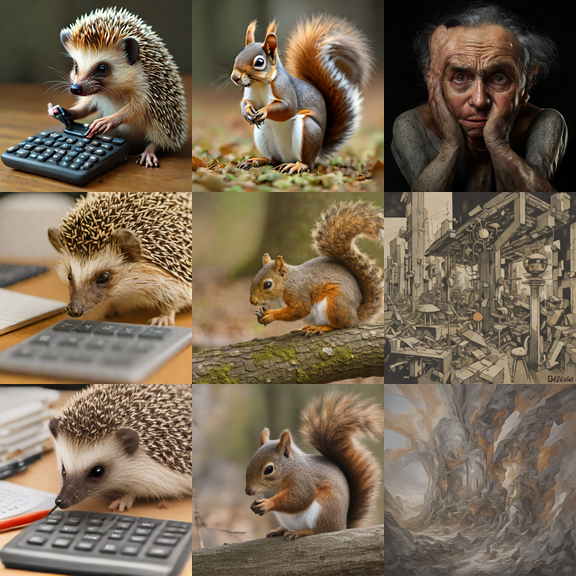
from PIL import Image# --- eval prompts: a slice of PartiPrompts, with an inline fallback ---------------FALLBACK_PROMPTS = ["a photograph of an astronaut riding a horse on a beach at sunset","a bowl of soup that is also a portal to another dimension","a corgi wearing a red bowtie and a purple party hat","a bright neon sign that reads 'OPEN LATE' above a rainy city street","three blue cubes stacked on top of one red sphere, studio lighting","an oil painting of a fox reading a newspaper in a Victorian library",]try:from datasets import load_dataset pp = load_dataset("nateraw/parti-prompts", split="train", cache_dir=HF_CACHE)# Keep it small and hard: challenge categories that actually separate models. hard = pp.filter(lambda r: r["Challenge"] in {"Quantity", "Basic", "Imagination"}) EVAL_PROMPTS = [r["Prompt"] for r in hard.shuffle(seed=SEED).select(range(4))] EVAL_PROMPTS += FALLBACK_PROMPTS[3:5] # a text-rendering and a compositional probeprint(f"PartiPrompts loaded: {len(pp)} prompts, using {len(EVAL_PROMPTS)}")exceptExceptionas e: # offline / gated / schema change - the notebook still runsprint(f"PartiPrompts unavailable ({type(e).__name__}), using the inline fallback") EVAL_PROMPTS = FALLBACK_PROMPTSPROMPT = EVAL_PROMPTS[0] # the single prompt used for the per-model demo sectionsfor i, p inenumerate(EVAL_PROMPTS):print(f" [{i}] {p}")def image_grid(images, cols=None, cell=256, labels=None):"Tile PIL images into a single contact sheet. (ECharts cannot draw images; PIL can.)" cols = cols orlen(images) rows = (len(images) + cols -1) // cols sheet = Image.new("RGB", (cols * cell, rows * cell), (24, 24, 24))for i, im inenumerate(images): sheet.paste(im.resize((cell, cell), Image.LANCZOS), ((i % cols) * cell, (i // cols) * cell))if labels:print(" | ".join(str(x) for x in labels))return sheet
PartiPrompts loaded: 1632 prompts, using 6
  [0] a hedgehog using a calculator
  [1] a squirrel
  [2] derision
  [3] a triangle with a smiling face
  [4] a bright neon sign that reads 'OPEN LATE' above a rainy city street
  [5] three blue cubes stacked on top of one red sphere, studio lighting
8. Stable Diffusion 1.5 (the reference implementation of section 3)
stable-diffusion-v1-5/stable-diffusion-v1-5 (0.86B U-Net + CLIP-L text encoder + 8x VAE, 512x512, CreativeML OpenRAIL-M). Nobody ships this in 2026 for quality - it cannot spell, its anatomy is bad, and its prompt adherence is weak. It is here because it is the smallest complete example of the machine in section 3, it is 4 GB, and the entire LoRA/ControlNet ecosystem still targets it.
Note the runwayml/stable-diffusion-v1-5 repo was deleted from the Hub in August 2024; the community mirror stable-diffusion-v1-5/stable-diffusion-v1-5 is the live id.
We also swap the default PNDM scheduler for DPM-Solver++ 2M with Karras sigmas - a free upgrade that gets a good image in ~20 steps instead of 50.
safety_checker=None disables the built-in NSFW classifier. That is fine for a notebook and not fine for anything user-facing (section 15).
from diffusers import DPMSolverMultistepScheduler, StableDiffusionPipelinesd15 = StableDiffusionPipeline.from_pretrained("stable-diffusion-v1-5/stable-diffusion-v1-5", torch_dtype=dtype, safety_checker=None, # see section 15 before shipping this requires_safety_checker=False, cache_dir=HF_CACHE,)sd15.scheduler = DPMSolverMultistepScheduler.from_config( sd15.scheduler.config, algorithm_type="dpmsolver++", use_karras_sigmas=True)offload(sd15) # not .to(device): keeps VRAM flatsd15.vae.enable_slicing()sd15.set_progress_bar_config(disable=True)# The four parts of section 3.1, with their real sizes:for name in ["text_encoder", "unet", "vae"]: n =sum(p.numel() for p ingetattr(sd15, name).parameters())print(f" {name:14s}{n /1e6:7.1f} M params")t0 = time.perf_counter()image = sd15(PROMPT, num_inference_steps=25, guidance_scale=7.5, generator=gen()).images[0]print(f"\n{time.perf_counter() - t0:.1f}s | {PROMPT}")vram("sd15 generate")image
offload: sequential (5.2 GB VRAM free - GPU busy, expect slow steps)
  text_encoder     123.1 M params
  unet             859.5 M params
  vae               83.7 M params

9.5s  |  a hedgehog using a calculator
VRAM sd15 generate         0.61 GB allocated /  0.80 GB reserved
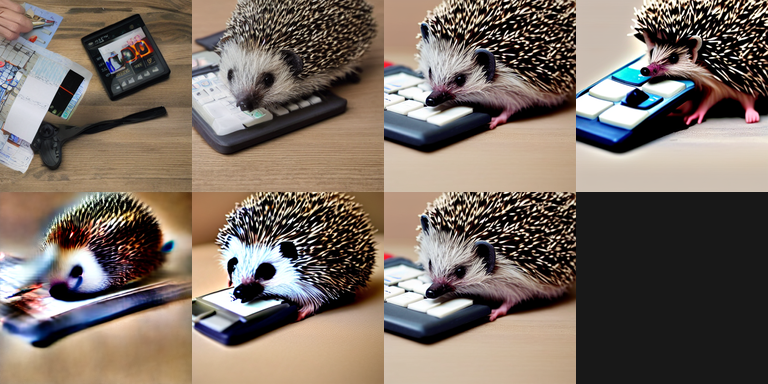
# (b) What the two big knobs actually do. Same seed everywhere, so every difference# you see is the knob, not the noise.grid, labels = [], []for g in [1.0, 3.0, 7.5, 15.0]: grid.append(sd15(PROMPT, num_inference_steps=25, guidance_scale=g, generator=gen()).images[0]) labels.append(f"cfg={g}")for s in [4, 8, 25]: grid.append(sd15(PROMPT, num_inference_steps=s, guidance_scale=7.5, generator=gen()).images[0]) labels.append(f"steps={s}")# Read the top row left-to-right: cfg=1 ignores half the prompt; cfg=15 is saturated# and burnt. Bottom row: 4 steps is mush, 8 is close, 25 is converged - past ~30 the# extra compute buys nothing.print(labels)image_grid(grid, cols=4, cell=192)
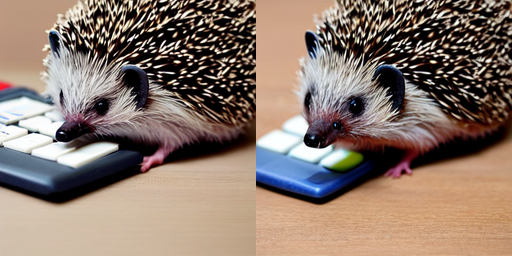
# (d) Negative prompts. This is literally the unconditional branch of the CFG equation# in section 3.3 with content in it - so it only works when real CFG is running# (guidance_scale > 1). A distilled model at guidance_scale=0.0 cannot use it at all.NEG ="blurry, low quality, jpeg artifacts, watermark, text, deformed hands, extra limbs"pair = [ sd15(PROMPT, num_inference_steps=25, guidance_scale=7.5, generator=gen()).images[0], sd15(PROMPT, negative_prompt=NEG, num_inference_steps=25, guidance_scale=7.5, generator=gen()).images[0],]print("left: no negative prompt | right: negative prompt")sheet = image_grid(pair, cols=2, cell=256)del sd15, grid, pairfree_memory()vram("after sd15")sheet
left: no negative prompt   |   right: negative prompt
VRAM after sd15            0.61 GB allocated /  0.66 GB reserved
stabilityai/sdxl-turbo - SDXL’s 2.6B U-Net distilled with Adversarial Diffusion Distillation into a 1-4 step sampler. This is the cell that makes the section-3.6 point concrete: an image in one forward pass, ~10-20x faster than the 25-step SD 1.5 above.
Two rules the model imposes:
guidance_scale=0.0. It was distilled without CFG. Passing a guidance scale > 0 does not “improve adherence”, it produces garbage - and it means no negative prompt.
512x512. Turbo was trained at 512; ask for 1024 and you get duplicated subjects.
Licence: research-only (STAI Non-Commercial). Use SDXL-Lightning (ByteDance/SDXL-Lightning, OpenRAIL++) if you need a commercially usable 4-step SDXL - it is also visibly better at 4 steps.
/home/bthek1/Knowledge/.venv/lib/python3.14/site-packages/diffusers/pipelines/stable_diffusion_xl/pipeline_stable_diffusion_xl.py:748: FutureWarning: `upcast_vae` is deprecated and will be removed in version 1.0.0. `upcast_vae` is deprecated. Please use `pipe.vae.to(torch.float32)`. For more details, please refer to: https://github.com/huggingface/diffusers/pull/12619#issue-3606633695.
  deprecate(
There are modules in AutoencoderKL that should be kept in float32: []. Casting directly with `to()` can lead to inconsistent results; set `torch_dtype` in `from_pretrained()` instead to keep these modules in float32.
There are modules in AutoencoderKL that should be kept in float32: []. Casting directly with `to()` can lead to inconsistent results; set `torch_dtype` in `from_pretrained()` instead to keep these modules in float32.
1 step(s): 9.39s
There are modules in AutoencoderKL that should be kept in float32: []. Casting directly with `to()` can lead to inconsistent results; set `torch_dtype` in `from_pretrained()` instead to keep these modules in float32.
There are modules in AutoencoderKL that should be kept in float32: []. Casting directly with `to()` can lead to inconsistent results; set `torch_dtype` in `from_pretrained()` instead to keep these modules in float32.
2 step(s): 2.98s
There are modules in AutoencoderKL that should be kept in float32: []. Casting directly with `to()` can lead to inconsistent results; set `torch_dtype` in `from_pretrained()` instead to keep these modules in float32.
There are modules in AutoencoderKL that should be kept in float32: []. Casting directly with `to()` can lead to inconsistent results; set `torch_dtype` in `from_pretrained()` instead to keep these modules in float32.
stabilityai/stable-diffusion-3.5-medium - 2.5B MMDiT, rectified flow, three text encoders (CLIP-L + OpenCLIP-G + T5-XXL). This is the first modern architecture in the notebook: joint text-image attention (section 3.5), which is why it can render short text strings that SD 1.5 and SDXL cannot.
Memory. The 2.5B transformer is not the problem - T5-XXL is 4.7B params (~9.4 GB in fp16) and would blow the card on its own. Diffusers lets you pass text_encoder_3=None, tokenizer_3=None and fall back to the two CLIP towers: the model still works, prompt adherence on long prompts drops a little, and peak VRAM lands around 6 GB. That is the trade you want on a 3060. (Alternative: keep T5 but load it in 8-bit with bitsandbytes.)
Gated. The repo requires accepting the Stability Community Licence on the Hub; HF_TOKEN from .env is what authenticates it. The cell degrades gracefully if you have not.
from diffusers import StableDiffusion3Pipelinesd35 =Nonetry: sd35 = StableDiffusion3Pipeline.from_pretrained("stabilityai/stable-diffusion-3.5-medium", text_encoder_3=None, # drop T5-XXL: 4.7B params we cannot afford here tokenizer_3=None, torch_dtype=dtype, cache_dir=HF_CACHE, ) offload(sd35) sd35.vae.enable_slicing() sd35.vae.enable_tiling() sd35.set_progress_bar_config(disable=True) n =sum(p.numel() for p in sd35.transformer.parameters())print(f"MMDiT transformer: {n /1e9:.2f} B params") t0 = time.perf_counter() img = sd35( PROMPT, negative_prompt="", num_inference_steps=28, # the rectified-flow default; 20 is usually fine guidance_scale=4.5, # flow models like a *lower* CFG than SD 1.5 height=1024, width=1024, generator=gen(), ).images[0]print(f"{time.perf_counter() - t0:.1f}s") vram("sd35 generate")exceptExceptionas e:# 401/403 = you have not accepted the licence on the Hub for this gated repo.print(f"SD 3.5 Medium unavailable: {type(e).__name__}: {e}") img =Nonedel sd35free_memory()vram("after sd35")img
SD 3.5 Medium unavailable: GatedRepoError: 403 Client Error. (Request ID: Root=1-6a58a859-251736ae07f0b3f76c004240;091898dc-db17-4981-85f5-ddd0b87e5679)

Cannot access gated repo for url https://huggingface.co/stabilityai/stable-diffusion-3.5-medium/resolve/main/model_index.json.
Access to model stabilityai/stable-diffusion-3.5-medium is restricted and you are not in the authorized list. Visit https://huggingface.co/stabilityai/stable-diffusion-3.5-medium to ask for access.
VRAM after sd35            0.61 GB allocated /  0.66 GB reserved
11. SANA-Sprint 0.6B (the speed/size Pareto frontier)
Efficient-Large-Model/Sana_Sprint_0.6B_1024px_diffusers (NVIDIA + MIT HAN Lab). Three ideas stacked:
Linear-attention DiT - attention cost linear in the number of tokens, not quadratic, so 1024px (and 4K) is cheap.
Deep-compression autoencoder (DC-AE, 32x) - 4x fewer latent tokens than SD’s 8x VAE before the transformer even starts.
Hybrid distillation (continuous-time consistency + latent adversarial) down to 1-2 steps.
Result: 7.59 FID / 0.74 GenEval in one step, better than FLUX.1 [schnell] (7.94 / 0.71) at ~10x the speed and ~20x fewer parameters. It is the best answer on this box - 0.6B denoiser + a Gemma-2 text encoder, comfortably inside 12 GB at full 1024px.
Two quirks: it wants bfloat16 (Ampere or later; the 3060 qualifies) rather than fp16, and its scheduler is SCM, so num_inference_steps of 1 or 2 is the intended operating point, not a compromise.
Licence caveat: SANA weights are NVIDIA non-commercial. Great for research, not shippable.
from diffusers import SanaSprintPipeline# SANA needs bf16 (text encoder + VAE must not be fp16). bf16 needs Ampere+ (RTX 3060: yes).sana_dtype = torch.bfloat16 if (device !="cpu"and torch.cuda.is_bf16_supported()) else torch.float32sana = SanaSprintPipeline.from_pretrained("Efficient-Large-Model/Sana_Sprint_0.6B_1024px_diffusers", torch_dtype=sana_dtype, cache_dir=HF_CACHE,)offload(sana)sana.vae.enable_tiling()sana.set_progress_bar_config(disable=True)n =sum(p.numel() for p in sana.transformer.parameters())print(f"linear-DiT transformer: {n /1e6:.0f} M params (dtype {sana_dtype})")grid, labels = [], []for steps in [1, 2, 4]: t0 = time.perf_counter() img = sana( PROMPT, num_inference_steps=steps,# SCM quirk: the default intermediate_timesteps=1.3 is only valid at exactly# 2 steps - any other step count must pass None or check_inputs raises. intermediate_timesteps=1.3if steps ==2elseNone, guidance_scale=4.5, # *embedded* guidance (distilled), not a double CFG pass height=1024, width=1024, generator=gen(), ).images[0] dt = time.perf_counter() - t0 grid.append(img) labels.append(f"{steps} step ({dt:.2f}s)")print(f" {steps} step(s) @1024px: {dt:5.2f}s")print(labels)sheet = image_grid(grid, cols=3, cell=256)del sana, gridfree_memory()vram("after sana-sprint")sheet
12. FLUX-class models on a 12 GB card (4-bit + offload)
FLUX.1 [schnell] is a 12B MMDiT: ~24 GB in fp16, i.e. double this card. FLUX.2 [klein] 4B is ~13 GB in bf16 - still over. Neither fits naively, and pretending otherwise is how you OOM the whole container (not just the kernel).
Two things make them run here, and you need both:
4-bit weights via bitsandbytes (NF4). The transformer drops from ~24 GB to ~6-7 GB; the T5 text encoder gets the same treatment. Expect a small, usually invisible quality loss - and note 4-bit inference is not faster, just smaller (dequantization costs time).
enable_model_cpu_offload(), which keeps only the executing submodule resident. Reported peak with FLUX 4-bit + offload is ~8.5 GB VRAM.
This is genuinely slow on a 3060 (expect tens of seconds even at 4 steps), and it will page through the 12 GB of system RAM while loading. It is left off by default - flip RUN_FLUX = True if you want it, and close everything else first.
If you need FLUX-class quality routinely, the honest answers are: rent a 24 GB+ GPU, use the API, or use SANA-Sprint / FLUX.2 [klein] 4B and accept the trade.
Licence, loudly: FLUX.1 [schnell] and FLUX.2 [klein] 4B are Apache 2.0 (commercial use fine). FLUX.1 [dev], FLUX.2 [dev] and FLUX.2 [klein] 9B are under the BFL Non-Commercial licence - outputs from them cannot be used in a commercial product. This trips up more teams than any technical issue in this notebook.
RUN_FLUX =False# set True only if you have ~10 GB free VRAM and some patienceif RUN_FLUX and device !="cpu":from diffusers import BitsAndBytesConfig as DiffusersBnBfrom diffusers import FluxPipeline, FluxTransformer2DModelfrom transformers import BitsAndBytesConfig as TransformersBnBfrom transformers import T5EncoderModel flux_id ="black-forest-labs/FLUX.1-schnell"# Apache 2.0, 12B, ADD-distilled, 1-4 steps nf4 =dict(load_in_4bit=True, bnb_4bit_quant_type="nf4", bnb_4bit_compute_dtype=torch.bfloat16) text_encoder_2 = T5EncoderModel.from_pretrained( flux_id, subfolder="text_encoder_2", cache_dir=HF_CACHE, quantization_config=TransformersBnB(**nf4), torch_dtype=torch.bfloat16, ) transformer = FluxTransformer2DModel.from_pretrained( flux_id, subfolder="transformer", cache_dir=HF_CACHE, quantization_config=DiffusersBnB(**nf4), torch_dtype=torch.bfloat16, ) flux = FluxPipeline.from_pretrained( flux_id, text_encoder_2=text_encoder_2, transformer=transformer, torch_dtype=torch.bfloat16, cache_dir=HF_CACHE, ) offload(flux) # NOT .to(device) - it will not fit flux.vae.enable_slicing() flux.vae.enable_tiling() t0 = time.perf_counter() img = flux( PROMPT, num_inference_steps=4, # schnell is distilled for 1-4 guidance_scale=0.0, # guidance-distilled: embedded, not a double pass max_sequence_length=256, height=1024, width=1024, generator=gen(), ).images[0]print(f"FLUX.1-schnell (4-bit, 4 steps): {time.perf_counter() - t0:.1f}s") vram("flux 4-bit")del flux, transformer, text_encoder_2 free_memory() vram("after flux") display(img)else:print("RUN_FLUX is False - skipping. FLUX.1-schnell needs 4-bit + CPU offload on a 12 GB card;")print("FLUX.2 [klein] 4B (Apache 2.0, ~13 GB bf16) is the same story via Flux2KleinPipeline.")
RUN_FLUX is False - skipping. FLUX.1-schnell needs 4-bit + CPU offload on a 12 GB card;
FLUX.2 [klein] 4B (Apache 2.0, ~13 GB bf16) is the same story via Flux2KleinPipeline.
13. Head-to-head Benchmark
Same 6 prompts, same seed, same 1024px-or-native resolution, one pipeline live at a time. We record seconds per image and CLIPScore (the clip_score helper from section 4).
Read the caveats before reading the numbers:
6 prompts is a smoke test, not a leaderboard. A real evaluation is FID-30k on COCO plus GenEval plus a preference model (HPSv2/PickScore) plus, ultimately, humans. See the Artificial Analysis Arena.
CLIPScore saturates. A 0.02 gap between two models here is noise. What it will catch is a model that ignored the prompt entirely.
The step counts are not equal, deliberately - a 1-step distilled model and a 25-step base model is exactly the comparison you make in production. The scatter (quality vs latency) is the honest chart; the bar chart alone is misleading.
Hardware: RTX 3060, 12 GB, enable_model_cpu_offload() on every pipeline (which adds a second or two of transfer per image - so these latencies are pessimistic relative to a card that fits the model natively).
from diffusers import AutoPipelineForText2Image# (name, loader, call-kwargs). Each entry is loaded, measured, and freed before the next.BENCH = [ ("SD 1.5 (25 steps)", lambda: StableDiffusionPipeline.from_pretrained("stable-diffusion-v1-5/stable-diffusion-v1-5", torch_dtype=dtype, safety_checker=None, requires_safety_checker=False, cache_dir=HF_CACHE),dict(num_inference_steps=25, guidance_scale=7.5, height=512, width=512), dtype), ("SDXL-Turbo (1 step)", lambda: AutoPipelineForText2Image.from_pretrained("stabilityai/sdxl-turbo", torch_dtype=dtype, variant="fp16"if device !="cpu"elseNone, cache_dir=HF_CACHE),dict(num_inference_steps=1, guidance_scale=0.0, height=512, width=512), dtype), ("SDXL-Turbo (4 steps)", lambda: AutoPipelineForText2Image.from_pretrained("stabilityai/sdxl-turbo", torch_dtype=dtype, variant="fp16"if device !="cpu"elseNone, cache_dir=HF_CACHE),dict(num_inference_steps=4, guidance_scale=0.0, height=512, width=512), dtype), ("SANA-Sprint (2 steps)", lambda: SanaSprintPipeline.from_pretrained("Efficient-Large-Model/Sana_Sprint_0.6B_1024px_diffusers", torch_dtype=sana_dtype, cache_dir=HF_CACHE),dict(num_inference_steps=2, guidance_scale=4.5, height=1024, width=1024), sana_dtype),]results, gallery = {}, {}for name, loader, kwargs, _dt in BENCH:try: pipe = loader() offload(pipe) pipe.vae.enable_slicing() pipe.set_progress_bar_config(disable=True) imgs, t0 = [], time.perf_counter()for p in EVAL_PROMPTS: imgs.append(pipe(p, generator=gen(), **kwargs).images[0]) secs = (time.perf_counter() - t0) /len(EVAL_PROMPTS) scores = clip_score(imgs, EVAL_PROMPTS) results[name] = (sum(scores) /len(scores), secs) gallery[name] = imgs[:3] # keep 3 thumbnails, drop the rest to save RAMprint(f"{name:24s} CLIPScore {results[name][0]:.3f}{secs:5.2f} s/image")exceptExceptionas e:print(f"{name:24s} SKIPPED: {type(e).__name__}: {e}")finally: pipe =None free_memory() # free BEFORE loading the next one - non-negotiable at 12 GB vram(f"after {name}")
SD 1.5 (25 steps)        SKIPPED: NameError: name 'StableDiffusionPipeline' is not defined
VRAM after SD 1.5 (25 steps)  0.61 GB allocated /  0.66 GB reserved
offload: model-level (11.7 GB VRAM free)
There are modules in AutoencoderKL that should be kept in float32: []. Casting directly with `to()` can lead to inconsistent results; set `torch_dtype` in `from_pretrained()` instead to keep these modules in float32.
There are modules in AutoencoderKL that should be kept in float32: []. Casting directly with `to()` can lead to inconsistent results; set `torch_dtype` in `from_pretrained()` instead to keep these modules in float32.
There are modules in AutoencoderKL that should be kept in float32: []. Casting directly with `to()` can lead to inconsistent results; set `torch_dtype` in `from_pretrained()` instead to keep these modules in float32.
There are modules in AutoencoderKL that should be kept in float32: []. Casting directly with `to()` can lead to inconsistent results; set `torch_dtype` in `from_pretrained()` instead to keep these modules in float32.
There are modules in AutoencoderKL that should be kept in float32: []. Casting directly with `to()` can lead to inconsistent results; set `torch_dtype` in `from_pretrained()` instead to keep these modules in float32.
There are modules in AutoencoderKL that should be kept in float32: []. Casting directly with `to()` can lead to inconsistent results; set `torch_dtype` in `from_pretrained()` instead to keep these modules in float32.
There are modules in AutoencoderKL that should be kept in float32: []. Casting directly with `to()` can lead to inconsistent results; set `torch_dtype` in `from_pretrained()` instead to keep these modules in float32.
There are modules in AutoencoderKL that should be kept in float32: []. Casting directly with `to()` can lead to inconsistent results; set `torch_dtype` in `from_pretrained()` instead to keep these modules in float32.
There are modules in AutoencoderKL that should be kept in float32: []. Casting directly with `to()` can lead to inconsistent results; set `torch_dtype` in `from_pretrained()` instead to keep these modules in float32.
There are modules in AutoencoderKL that should be kept in float32: []. Casting directly with `to()` can lead to inconsistent results; set `torch_dtype` in `from_pretrained()` instead to keep these modules in float32.
There are modules in AutoencoderKL that should be kept in float32: []. Casting directly with `to()` can lead to inconsistent results; set `torch_dtype` in `from_pretrained()` instead to keep these modules in float32.
There are modules in AutoencoderKL that should be kept in float32: []. Casting directly with `to()` can lead to inconsistent results; set `torch_dtype` in `from_pretrained()` instead to keep these modules in float32.
There are modules in AutoencoderKL that should be kept in float32: []. Casting directly with `to()` can lead to inconsistent results; set `torch_dtype` in `from_pretrained()` instead to keep these modules in float32.
There are modules in AutoencoderKL that should be kept in float32: []. Casting directly with `to()` can lead to inconsistent results; set `torch_dtype` in `from_pretrained()` instead to keep these modules in float32.
There are modules in AutoencoderKL that should be kept in float32: []. Casting directly with `to()` can lead to inconsistent results; set `torch_dtype` in `from_pretrained()` instead to keep these modules in float32.
There are modules in AutoencoderKL that should be kept in float32: []. Casting directly with `to()` can lead to inconsistent results; set `torch_dtype` in `from_pretrained()` instead to keep these modules in float32.
There are modules in AutoencoderKL that should be kept in float32: []. Casting directly with `to()` can lead to inconsistent results; set `torch_dtype` in `from_pretrained()` instead to keep these modules in float32.
There are modules in AutoencoderKL that should be kept in float32: []. Casting directly with `to()` can lead to inconsistent results; set `torch_dtype` in `from_pretrained()` instead to keep these modules in float32.
There are modules in AutoencoderKL that should be kept in float32: []. Casting directly with `to()` can lead to inconsistent results; set `torch_dtype` in `from_pretrained()` instead to keep these modules in float32.
There are modules in AutoencoderKL that should be kept in float32: []. Casting directly with `to()` can lead to inconsistent results; set `torch_dtype` in `from_pretrained()` instead to keep these modules in float32.
There are modules in AutoencoderKL that should be kept in float32: []. Casting directly with `to()` can lead to inconsistent results; set `torch_dtype` in `from_pretrained()` instead to keep these modules in float32.
There are modules in AutoencoderKL that should be kept in float32: []. Casting directly with `to()` can lead to inconsistent results; set `torch_dtype` in `from_pretrained()` instead to keep these modules in float32.
There are modules in AutoencoderKL that should be kept in float32: []. Casting directly with `to()` can lead to inconsistent results; set `torch_dtype` in `from_pretrained()` instead to keep these modules in float32.
There are modules in AutoencoderKL that should be kept in float32: []. Casting directly with `to()` can lead to inconsistent results; set `torch_dtype` in `from_pretrained()` instead to keep these modules in float32.
from pyecharts import options as optsfrom pyecharts.charts import Barbar = ( Bar() .add_xaxis(list(df["model"])) .add_yaxis("CLIPScore", [round(float(x), 3) for x in df["clip_score"]]) .set_global_opts( title_opts=opts.TitleOpts( title="Prompt adherence (CLIPScore, ViT-B/32)", subtitle=f"{len(EVAL_PROMPTS)} PartiPrompts-style prompts, seed {SEED}, RTX 3060 - smoke test, not a leaderboard", ), xaxis_opts=opts.AxisOpts(name="model", axislabel_opts=opts.LabelOpts(rotate=20)), yaxis_opts=opts.AxisOpts(name="CLIPScore", min_=0.5), tooltip_opts=opts.TooltipOpts(trigger="axis"), ))bar.render_notebook()
from pyecharts.charts import Scatter# The chart that actually matters: quality against latency. Up and to the LEFT wins.scatter = Scatter()scatter.add_xaxis([round(float(s), 2) for s in df["sec_per_image"]])for _, r in df.iterrows(): scatter.add_yaxis( r["model"], [[round(float(r["sec_per_image"]), 2), round(float(r["clip_score"]), 3)]], symbol_size=18, label_opts=opts.LabelOpts(is_show=False), )scatter.set_global_opts( title_opts=opts.TitleOpts( title="Quality vs latency", subtitle="up and to the left is better; distilled models trade diversity for the left half", ), xaxis_opts=opts.AxisOpts(type_="value", name="seconds / image"), yaxis_opts=opts.AxisOpts(type_="value", name="CLIPScore", min_=0.5), tooltip_opts=opts.TooltipOpts(trigger="item"), legend_opts=opts.LegendOpts(pos_top="8%"),)# Final cleanup: the CLIP scorer from section 4 is the last model still resident.del clip, clip_procfree_memory()vram("final")scatter.render_notebook()
VRAM final 0.01 GB allocated / 0.02 GB reserved
14. Common Frameworks
Text-to-image is the one task in this folder with a genuine consumer ecosystem attached, and it shows: the tooling is split between a Python library that researchers and backend engineers use (diffusers) and node-graph applications that artists use (ComfyUI). They run the same weights. Knowing both matters, because the community ships quantised checkpoints, LoRAs and new conditioning tricks to ComfyUI first and to diffusers weeks later.
Distribution distance, prompt adherence, and a learned human-preference proxy
Apache 2.0 / MIT
Comparing checkpoints or LoRAs. FID alone is nearly useless at these sample sizes; preference scores correlate far better with what people pick
The 2026 default stack is diffusers for anything programmatic, ComfyUI for anything exploratory, a LoRA rather than a fine-tune, torch.compile before any model change, and a preference score rather than FID to decide. Quantisation is not optional on a 12 GB card.
The common wrong turn is choosing a model by benchmark rather than by step count. A model that needs 50 steps at 3 s each is a different product from one that needs 4, and the distilled models (SDXL-Turbo, SANA-Sprint) are usually good enough for anything interactive. The second is shipping without provenance or an output classifier - the safety checker disabled in section 7 is weak, and every open checkpoint can be prompted past it.
15. Going Further
Fine-tuning and personalisation (all supported by diffusers + peft, all runnable on 12 GB for SD 1.5 / SDXL / SANA):
LoRA - low-rank adapters on the denoiser’s attention layers. The default. 10-100 MB per style, minutes to train, composable at inference. diffusers LoRA training.
DreamBooth - fine-tune the whole denoiser on 3-20 images of one subject with a rare-token identifier. Best identity fidelity, worst overfitting/language-drift; almost always done as a LoRA now. Guide.
Textual inversion - learn a single new embedding (a few KB), freeze everything else. Weakest but cheapest; good for a style token.
Preference tuning - Diffusion-DPO / GRPO against a reward model (PickScore, HPSv2, ImageReward). This, not more data, is what moved the 2025-26 models up the Arena.
Control and conditioning (see 06_Image_to_Image): ControlNet (condition on depth/pose/canny/segmentation - the standard way to get structural control), T2I-Adapter (lighter, same idea), IP-Adapter (condition on a reference image for style or identity, no training), and inpainting/outpainting pipelines. In 2026 the frontier models fold this in natively - FLUX.2’s multi-reference support and Qwen-Image-Edit do editing and reference-conditioning in the base model, no adapter required.
Safety, provenance, and licensing - do not skip this before shipping:
The safety checker (StableDiffusionSafetyChecker) we disabled above is a weak CLIP-based NSFW classifier; production systems layer prompt filtering, output classification, and human review. Assume any open checkpoint can be prompted past it.
Watermarking and provenance: invisible-watermark (what SDXL ships with) and, increasingly, C2PA Content Credentials (signed manifests, adopted by Adobe, OpenAI, Google, and required by the EU AI Act’s transparency obligations for synthetic media). Sign your outputs.
Licensing is the real minefield. The weights licence (Apache 2.0 vs BFL Non-Commercial vs OpenRAIL vs Stability Community) governs commercial use; the training data provenance (Re-LAION, and the pre-2024 checkpoints trained on uncleaned LAION) governs your legal exposure; and the output copyright status varies by jurisdiction. FLUX.1 [dev] and SDXL-Turbo are the two most common accidental violations - both are non-commercial, and both are all over tutorials that do not say so.
Related notebooks:06_Image_to_Image (img2img, inpainting, ControlNet, IP-Adapter), 08_Unconditional_Image_Generation (diffusion without the text encoder), 10_Text_to_Video (this exact recipe plus a time axis), 14_Text_to_3D, 05_Image_to_Text (the inverse, and the source of the VLM re-captioning that trained these models).